You are using an out of date browser. It may not display this or other websites correctly.
You should upgrade or use an alternative browser.
You should upgrade or use an alternative browser.
F
fundiver199
Legend
Loyaler


- Joined
- Jun 3, 2019
- Total posts
- 16,168
- Awards
- 2
- Poker Chips
- 1,057
- Casino Coins
- 0
- #2
The deciding factor is not, how much of the price pool consist of bounties, but how many chips the bounties are worth. If this case you can win the bounty of the all-in player but not the limper. So you convert the all-in players bounty to chips and calculate, how much this change your pot odds. I dont have the information nessesary to make the calculation here, so I will just illustrate, how to do it, with a more simple example.
You are playing a traditional PKO, where half the price pool is bounties, and half the bounty is paid out, when you known someone out. So for instance its a $5.5 PKO, and if you knock someone out, who has the starting bounty, you win $1.25. This mean, that at the beginning of the tournament, a bounty is worth 25% of the starting stack. So for instance 2.500 chips, if the starting stack is 10.000 chips.
Lets say blinds are 200/400, and you have grown your stack to 18.000 chips. You open to 1.000 chips from CO, BTN jam for 8.000 chips, and the blinds fold. There is also a total ante of 400. This mean you have to pay 7.000 for a chance to win 2 x 8.000 + 1.000 in blinds and ante = 17.000. You therefore need 41,1% equity to break even.
However factoring in the value of the bounty, you can actually win 19.500 chips, so you only need 35,9% equity. And then you just use a program like Equilab (off the tables of course) to find out, how much this widen your calling range. In this case it will widen it some, but you will likely still have a range, that open and fold to his jam.
You are playing a traditional PKO, where half the price pool is bounties, and half the bounty is paid out, when you known someone out. So for instance its a $5.5 PKO, and if you knock someone out, who has the starting bounty, you win $1.25. This mean, that at the beginning of the tournament, a bounty is worth 25% of the starting stack. So for instance 2.500 chips, if the starting stack is 10.000 chips.
Lets say blinds are 200/400, and you have grown your stack to 18.000 chips. You open to 1.000 chips from CO, BTN jam for 8.000 chips, and the blinds fold. There is also a total ante of 400. This mean you have to pay 7.000 for a chance to win 2 x 8.000 + 1.000 in blinds and ante = 17.000. You therefore need 41,1% equity to break even.
However factoring in the value of the bounty, you can actually win 19.500 chips, so you only need 35,9% equity. And then you just use a program like Equilab (off the tables of course) to find out, how much this widen your calling range. In this case it will widen it some, but you will likely still have a range, that open and fold to his jam.
F
fundiver199
Legend
Loyaler
- Joined
- Jun 3, 2019
- Total posts
- 16,168
- Awards
- 2
- Poker Chips
- 1,057
- Casino Coins
- 0
- #3
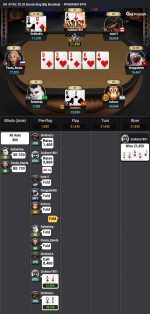
In this hand he had a $1 bounty, so if the buyin was $3+0,2, his bounty was worth 1/3 of the starting stack. As money are taken out of the price pool due to bounties being paid and/or players reaching the payouts, the value of chips go up. If for instance 1/3 of the price pool is paid out, then a $1 bounty is worth 1/2 a starting stack. However since you did not tell the starting stack, the calculation can not be performed.
If the starting stack was 10.000 chips, his bounty was worth at least 3.333 chips. If you were closing the action, I think, this would make KJo a somewhat close decision. However here you were not closing the action. You had 3 other players behind you with larger stacks, including UTG, who should be on a tight range, even though this time he was apparently not.
And for that reason the bounty would need to be worth significantly more than 3.333 chips to make it worth risking your entire stack against the 3 players behind you including the UTG raiser with a hand as bad as KJo. Your question seem to be a little bit results oriented, since you would have won the hand this particular time.
If the starting stack was 10.000 chips, his bounty was worth at least 3.333 chips. If you were closing the action, I think, this would make KJo a somewhat close decision. However here you were not closing the action. You had 3 other players behind you with larger stacks, including UTG, who should be on a tight range, even though this time he was apparently not.
And for that reason the bounty would need to be worth significantly more than 3.333 chips to make it worth risking your entire stack against the 3 players behind you including the UTG raiser with a hand as bad as KJo. Your question seem to be a little bit results oriented, since you would have won the hand this particular time.
B
budaloto
Rock Star
Silver Level
- Joined
- May 10, 2025
- Total posts
- 149

- Poker Chips
- 221
- Casino Coins
- 0
- #4
Thanks, for the math explanation I will use in the future.fundiver199 said:The deciding factor is not, how much of the price pool consist of bounties, but how many chips the bounties are worth. If this case you can win the bounty of the all-in player but not the limper. So you convert the all-in players bounty to chips and calculate, how much this change your pot odds. I dont have the information nessesary to make the calculation here, so I will just illustrate, how to do it, with a more simple example.
You are playing a traditional PKO, where half the price pool is bounties, and half the bounty is paid out, when you known someone out. So for instance its a $5.5 PKO, and if you knock someone out, who has the starting bounty, you win $1.25. This mean, that at the beginning of the tournament, a bounty is worth 25% of the starting stack. So for instance 2.500 chips, if the starting stack is 10.000 chips.
Lets say blinds are 200/400, and you have grown your stack to 18.000 chips. You open to 1.000 chips from CO, BTN jam for 8.000 chips, and the blinds fold. There is also a total ante of 400. This mean you have to pay 7.000 for a chance to win 2 x 8.000 + 1.000 in blinds and ante = 17.000. You therefore need 41,1% equity to break even.
However factoring in the value of the bounty, you can actually win 19.500 chips, so you only need 35,9% equity. And then you just use a program like Equilab (off the tables of course) to find out, how much this widen your calling range. In this case it will widen it some, but you will likely still have a range, that open and fold to his jam.
B
budaloto
Rock Star
Silver Level
- Joined
- May 10, 2025
- Total posts
- 149
- Poker Chips
- 221
- Casino Coins
- 0
- #5
Thanks, for the math explanation I will use in the future.fundiver199 said:In this hand he had a $1 bounty, so if the buyin was $3+0,2, his bounty was worth 1/3 of the starting stack. As money are taken out of the price pool due to bounties being paid and/or players reaching the payouts, the value of chips go up. If for instance 1/3 of the price pool is paid out, then a $1 bounty is worth 1/2 a starting stack. However since you did not tell the starting stack, the calculation can not be performed.
If the starting stack was 10.000 chips, his bounty was worth at least 3.333 chips. If you were closing the action, I think, this would make KJo a somewhat close decision. However here you were not closing the action. You had 3 other players behind you with larger stacks, including UTG, who should be on a tight range, even though this time he was apparently not.
And for that reason the bounty would need to be worth significantly more than 3.333 chips to make it worth risking your entire stack against the 3 players behind you including the UTG raiser with a hand as bad as KJo. Your question seem to be a little bit results oriented, since you would have won the hand this particular time.