Triple Barrel 200bb Deep – What’s the Best River Size Bet (CoinPoker $200 Special)

T

tiscoatthedisco

Rising Star
Bronze Level
Joined
Aug 2, 2025
Total posts
14
SE
Poker Chips
43
  • #1
I’m playing the $200 Special on CoinPoker, early stage, ~200bb effective in a deep MTT structure.
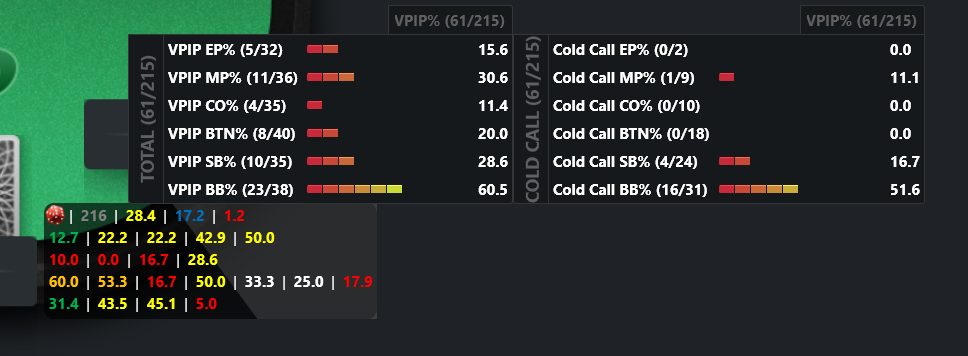
Villain is a fairly loose BB defender with a 51.6% cold call BB stat.
Given the depth, I actually think my BTN open size could have been bigger (2.5–2.7x instead of 2.1x), and that’s something I’ll adjust going forward.


-------------------------------------------------
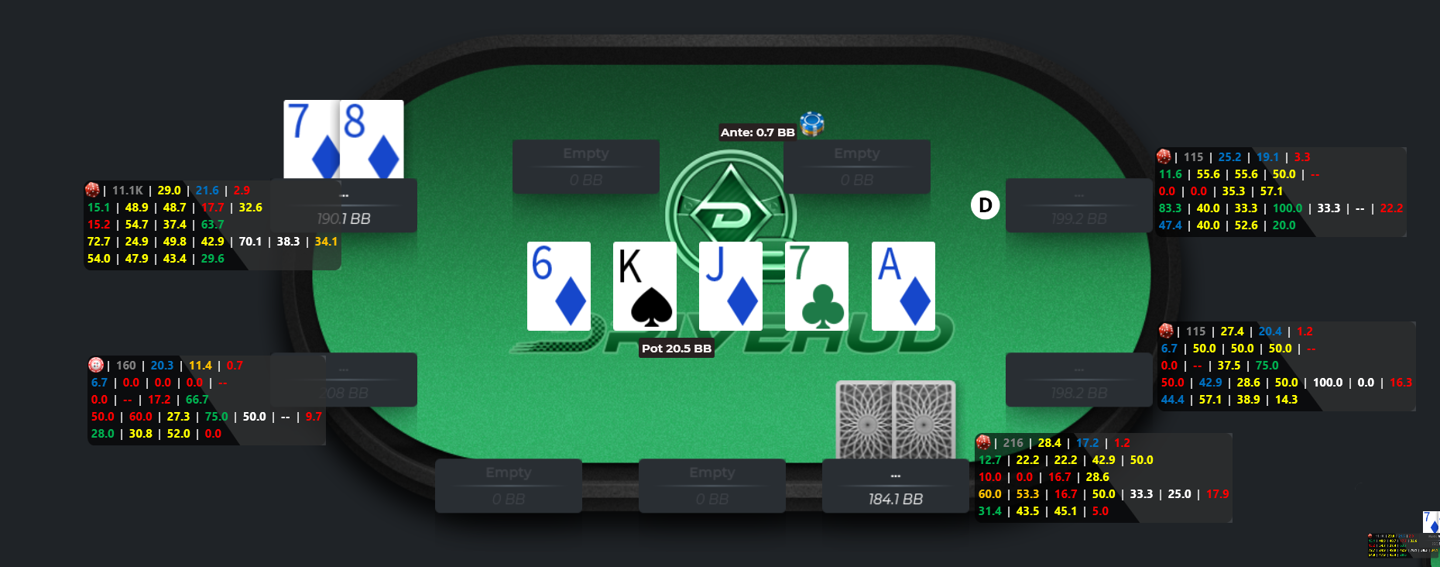


Hand:

NLH – CoinPoker $200 Special – Early Stage (200bb deep)
HERO opens BTN with 8♦7♦, BB cold-calls (51% CC stat).

Flop – 6♦ K♠ J♦ – Pot 5.4bb
BB checks, Hero c-bets 1.8bb, BB calls.

Turn – 7♣ – Pot 9bb
BB checks, Hero barrels 75% (5.7bb), BB calls.
I think this turn is a mandatory barrel with pair + flush draw vs a very wide defend. Folds out better one-pair hands, denies equity from all the Qx/Tx gutters, and sets up a lot of good river runouts.

River – A♦ – Pot ~22.5bb
BB checks, Hero bets ~65% (13.3bb).
Villain folds.

-----------------------------------

My thought process

Up to the river I think the line plays well:

Flop c-bet with our equity hand is standard.

Turn 7♣ improves us to pair + flush draw. This is a super natural barrel 200bb deep: fold equity + showdown improvement + clean river outs.

The A♦ river is where I got stuck.

We make the A-high flush, but:

Villain’s calling range on flop + turn is very diamond-heavy.

Better diamonds (K♦, Q♦, T♦, 9♦) are definitely in there.

Most Kx/Jx/7x without a diamond likely fold to a big triple barrel.

What do we realistically get called by that we beat?

Maybe:
AJ, AT♦x, A6

.
But it’s not a huge list, and many players overfold vs large sizing on 200bb rivers.

That’s why I’m unsure if the 65% pot bet is optimal.

Possible adjustments I considered

(1) Small sizing (35–45% pot):

Targets weaker flushes more effectively

Might get crying calls from Kx/Jx with a diamond blocker

Doesn’t isolate myself vs the top of his flush range

Easy fold vs a raise

(2) Overbet:

Makes my line look like a busted draw bomb

Could get looked up by K♦x/Q♦x

But feels too thin with A8♦ 200bb deep

Raises the chance I value-own myself vs the nut diamond region

My leaning:

Small sizing (~40% pot) seems cleaner and targets the exact part of villain’s range I beat.
Betting big forces him to fold too much of the hands I want value from and mostly continue with better flushes.

Still curious to hear what people think:

Is a smaller value bet best?

Is the overbet bluff-rep line actually stronger at this depth?

Do you prefer checking back sometimes with the A8♦ flush?


F

fundiver199

Legend
Loyaler
Joined
Jun 3, 2019
Total posts
16,099
Awards
2
Poker Chips
1,019
  • #2
Preflop
Standard open. As you say, could be larger with deep stack.

Flop
I think, you could consider a larger sizing with this hand to get more outright folds on the flop. You have no showdown value with 8 high, so you dont want to force him to call you light with A high and what not. But if you want to bet small with your entire range, this is also fine.

Turn
Here I disagree with your line and thought process. You turned a pair, so now you have showdown value, especially after betting small on the flop. So rather than a mandatory barrel, I would say, this is almost a mandatory check back. He is not folding a K, and probably not a J either, so your hand is to strong to bluff. And its a disaster to get check-raised, because then the value of your pair shrink tremendously, and the value of your 8 high flush also shrink, if you make it.

River
You made your flush, so now you obviously have to bet for value. It does suck a little bit, that its the ace, because this is a scare card to a K or J. So you are probably not getting called much here. You could consider sizing down, but if you are mainly getting called by two pair+ anyway, then a larger sizing is more profitable.
 
  • Like
Reactions: eetenor
fa1920

fa1920

Visionary
Bronze Level
Joined
Dec 2, 2013
Total posts
887
Awards
1
Poker Chips
342
  • #3
That is a very fair point to consider. Looking closer at the villain's profile, a 51% BB cold call stat indicates you are dealing with a massive station, which heavily dictates their river calling range.

The flop and turn barrels are standard and make total sense to deny equity against such a wide range.

The river is tricky. Even though the Ad hits, your flush is capped by the 8, meaning any higher diamond has you beat. However, because this specific villain is so loose and passive, their continuing range isn't exclusively better flushes. A bad player with those stats will absolutely find excuses to call with worse hands. They are never folding QT that just rivered a broadway straight, and they will likely stubbornly call down with random two-pair combos or slow-played sets that got scared of the board texture.

Because they have so many of these hands, checking back is actually too passive and misses out on thin value.

But betting 65% pot is still a mistake. That large sizing is a classic way to value-own yourself because it folds out exactly the stubborn hands you want to keep in (like those sets and weak straights) and isolates you against the better flushes.

As for the overbet bluff at 200bb deep, trying to rep the nut flush against someone who hates folding is just torching chips.

Your initial instinct for a smaller sizing is definitely the optimal line here. A block bet around 25-30% pot perfectly targets those misplayed sets, QT, and stubborn pairs for crying calls, while keeping the pot small enough that you can easily fold if they wake up with a check-raise
 
eetenor

eetenor

Legend
Loyaler
Joined
Mar 5, 2019
Total posts
2,787
Awards
2
Poker Chips
646
  • #4
fa1920 said:
That is a very fair point to consider. Looking closer at the villain's profile, a 51% BB cold call stat indicates you are dealing with a massive station, which heavily dictates their river calling range.

The flop and turn barrels are standard and make total sense to deny equity against such a wide range.

The river is tricky. Even though the Ad hits, your flush is capped by the 8, meaning any higher diamond has you beat. However, because this specific villain is so loose and passive, their continuing range isn't exclusively better flushes. A bad player with those stats will absolutely find excuses to call with worse hands. They are never folding QT that just rivered a broadway straight, and they will likely stubbornly call down with random two-pair combos or slow-played sets that got scared of the board texture.

Because they have so many of these hands, checking back is actually too passive and misses out on thin value.

But betting 65% pot is still a mistake. That large sizing is a classic way to value-own yourself because it folds out exactly the stubborn hands you want to keep in (like those sets and weak straights) and isolates you against the better flushes.

As for the overbet bluff at 200bb deep, trying to rep the nut flush against someone who hates folding is just torching chips.

Your initial instinct for a smaller sizing is definitely the optimal line here. A block bet around 25-30% pot perfectly targets those misplayed sets, QT, and stubborn pairs for crying calls, while keeping the pot small enough that you can easily fold if they wake up with a check-raise
At 100bb solver has BB calling 54% vs LJ--At 30bb solver is at 64% call---If the numbers hero has are over several different stack depths the BB does not have to be a massive calling station.

:unsure::geek:
 
eetenor

eetenor

Legend
Loyaler
Joined
Mar 5, 2019
Total posts
2,787
Awards
2
Poker Chips
646
  • #5
tiscoatthedisco said:
I’m playing the $200 Special on CoinPoker, early stage, ~200bb effective in a deep MTT structure.
Villain is a fairly loose BB defender with a 51.6% cold call BB stat.
Given the depth, I actually think my BTN open size could have been bigger (2.5–2.7x instead of 2.1x), and that’s something I’ll adjust going forward.


-------------------------------------------------
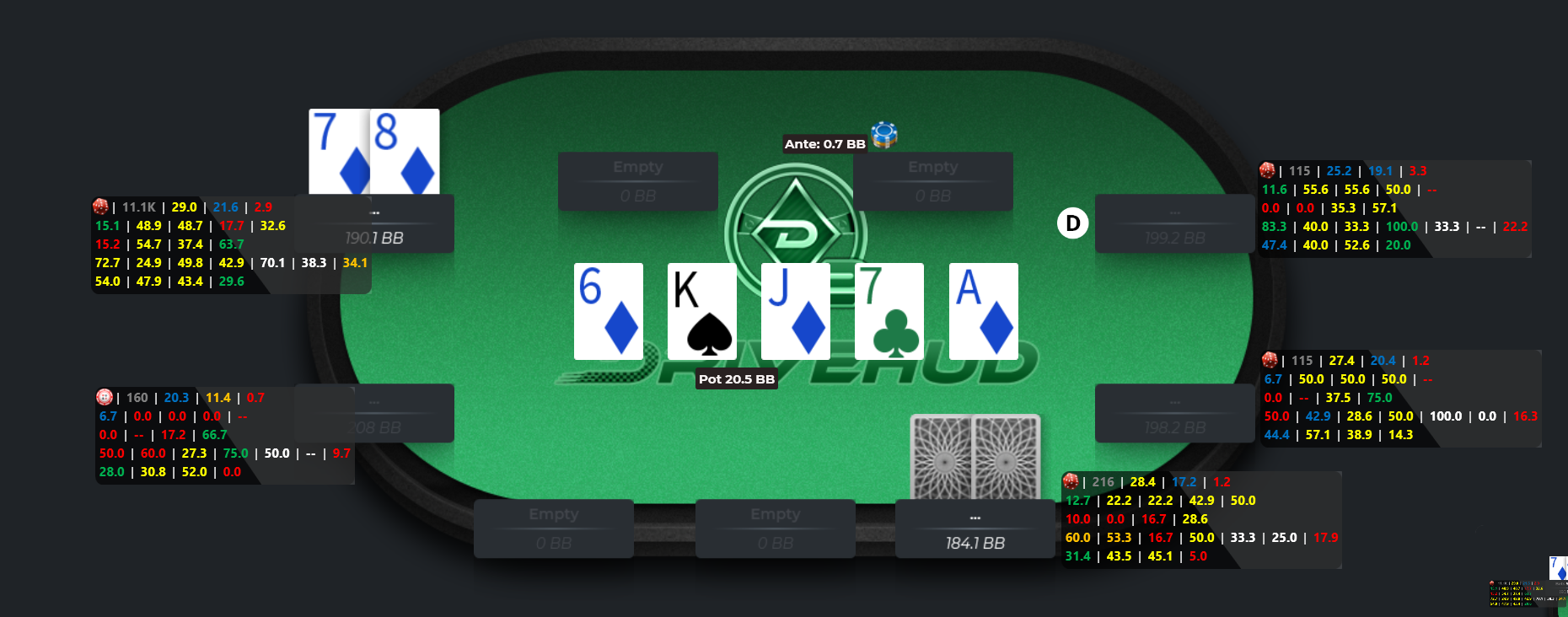


Hand:

NLH – CoinPoker $200 Special – Early Stage (200bb deep)
HERO opens BTN with 8♦7♦, BB cold-calls (51% CC stat).

Flop – 6♦ K♠ J♦ – Pot 5.4bb
BB checks, Hero c-bets 1.8bb, BB calls.

Turn – 7♣ – Pot 9bb
BB checks, Hero barrels 75% (5.7bb), BB calls.
I think this turn is a mandatory barrel with pair + flush draw vs a very wide defend. Folds out better one-pair hands, denies equity from all the Qx/Tx gutters, and sets up a lot of good river runouts.

River – A♦ – Pot ~22.5bb
BB checks, Hero bets ~65% (13.3bb).
Villain folds.

-----------------------------------

My thought process

Up to the river I think the line plays well:

Flop c-bet with our equity hand is standard.

Turn 7♣ improves us to pair + flush draw. This is a super natural barrel 200bb deep: fold equity + showdown improvement + clean river outs.

The A♦ river is where I got stuck.

We make the A-high flush, but:

Villain’s calling range on flop + turn is very diamond-heavy.

Better diamonds (K♦, Q♦, T♦, 9♦) are definitely in there.

Most Kx/Jx/7x without a diamond likely fold to a big triple barrel.

What do we realistically get called by that we beat?

Maybe:
AJ, AT♦x, A6

.
But it’s not a huge list, and many players overfold vs large sizing on 200bb rivers.

That’s why I’m unsure if the 65% pot bet is optimal.

Possible adjustments I considered

(1) Small sizing (35–45% pot):

Targets weaker flushes more effectively

Might get crying calls from Kx/Jx with a diamond blocker

Doesn’t isolate myself vs the top of his flush range

Easy fold vs a raise

(2) Overbet:

Makes my line look like a busted draw bomb

Could get looked up by K♦x/Q♦x

But feels too thin with A8♦ 200bb deep

Raises the chance I value-own myself vs the nut diamond region

My leaning:

Small sizing (~40% pot) seems cleaner and targets the exact part of villain’s range I beat.
Betting big forces him to fold too much of the hands I want value from and mostly continue with better flushes.

Still curious to hear what people think:

Is a smaller value bet best?

Is the overbet bluff-rep line actually stronger at this depth?

Do you prefer checking back sometimes with the A8♦ flush?


If you think it is an easy fold to a raise and you think the V calls more hands, lowering your size is fine. This runout is not the runout we can get max value from worse unless the player got funky on the river. You saying easy fold to a raise means that is not the case.


:unsure::geek:
 
fa1920

fa1920

Visionary
Bronze Level
Joined
Dec 2, 2013
Total posts
887
Awards
1
Poker Chips
342
  • #6
eetenor said:
At 100bb solver has BB calling 54% vs LJ--At 30bb solver is at 64% call---If the numbers hero has are over several different stack depths the BB does not have to be a massive calling station.

:unsure::geek:
You bring up a fair theoretical point regarding GTO BB defense frequencies in a vacuum, eetenor. However, my read wasn't based solely on the 51.6% cold call stat in isolation; it was based on the overall composition of his range according to the rest of the HUD pop-up provided by the OP.

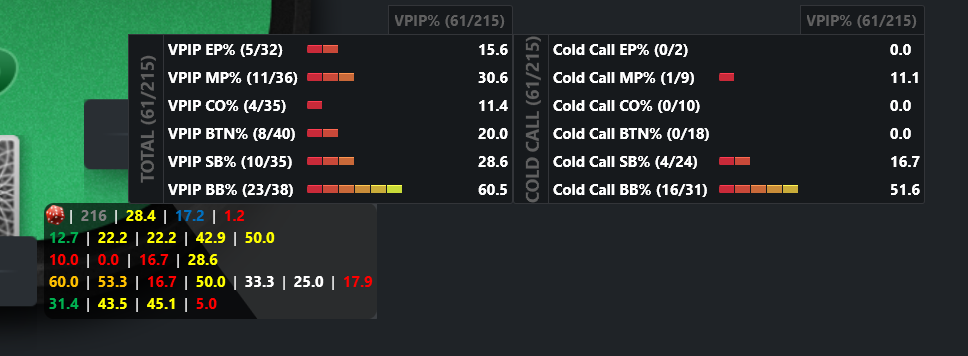
If you look at the unlabelled stat block in the bottom-left corner of the OP's screenshot, this villain's profile is 28.4 VPIP / 17.2 PFR with an overall 3-bet of exactly 1.2% across a 216-hand sample (the top line next to the dice icon: 216 | 28.4 | 17.2 | 1.2).

A solver defending the BB wide dynamically mixes in 3-bets to push equity and protect its range. Reaching a 51%+ BB cold call frequency while possessing a 1.2% overall 3-bet means he is virtually never 3-betting; he is just passively flatting his entire playable range preflop. That massive gap between VPIP and PFR combined with a near-zero 3-betting frequency is the textbook mathematical definition of a loose-passive station. I 100% stand by that initial read.

Furthermore, that extreme passivity ties directly into the deductive logic you pointed out in your reply to the OP regarding the river.

As you correctly noted, Hero cannot get max value from worse on this runout unless the villain 'gets funky'. The HUD data completely validates OP's assumption that the villain won't do that. A passive station with a 1.2% 3-bet is the exact opposite of a player who 'gets funky' or turns hands into bluff-raises. They arrive at the river with a bloated, capped range of stubborn bluff-catchers.

Therefore, betting big (65%) isolates us against better flushes, and sizing down to a 25-30% block bet is the optimal exploitative line. It targets their passive tendencies for thin value, perfectly aligning with the conclusion in your second post
 
eetenor

eetenor

Legend
Loyaler
Joined
Mar 5, 2019
Total posts
2,787
Awards
2
Poker Chips
646
  • #7
fa1920 said:
You bring up a fair theoretical point regarding GTO BB defense frequencies in a vacuum, eetenor. However, my read wasn't based solely on the 51.6% cold call stat in isolation; it was based on the overall composition of his range according to the rest of the HUD pop-up provided by the OP.

If you look at the unlabelled stat block in the bottom-left corner of the OP's screenshot, this villain's profile is 28.4 VPIP / 17.2 PFR with an overall 3-bet of exactly 1.2% across a 216-hand sample (the top line next to the dice icon: 216 | 28.4 | 17.2 | 1.2).

A solver defending the BB wide dynamically mixes in 3-bets to push equity and protect its range. Reaching a 51%+ BB cold call frequency while possessing a 1.2% overall 3-bet means he is virtually never 3-betting; he is just passively flatting his entire playable range preflop. That massive gap between VPIP and PFR combined with a near-zero 3-betting frequency is the textbook mathematical definition of a loose-passive station. I 100% stand by that initial read.

Furthermore, that extreme passivity ties directly into the deductive logic you pointed out in your reply to the OP regarding the river.

As you correctly noted, Hero cannot get max value from worse on this runout unless the villain 'gets funky'. The HUD data completely validates OP's assumption that the villain won't do that. A passive station with a 1.2% 3-bet is the exact opposite of a player who 'gets funky' or turns hands into bluff-raises. They arrive at the river with a bloated, capped range of stubborn bluff-catchers.

Therefore, betting big (65%) isolates us against better flushes, and sizing down to a 25-30% block bet is the optimal exploitative line. It targets their passive tendencies for thin value, perfectly aligning with the conclusion in your second post
All great points thanks for the share.
To clarify my point the V's natural tendencies to call wider in all positions and raise less actually allows them to play BB specifically closer to solver vs the LJ. Only top of range in that spot is mostly raise in the solver so even if they are missing the solver raises in lower freq spots they are not massively over calling in the BB was my point. Are they a station yes but 1 hand every orbit they play closer to solver than in any other spot.
We want to be aware of the shift in range dynamics for this player and all our players as they move thru each seat.

:unsure::geek:
 
  • Like
Reactions: fa1920
fa1920

fa1920

Visionary
Bronze Level
Joined
Dec 2, 2013
Total posts
887
Awards
1
Poker Chips
342
  • #8
eetenor said:
All great points thanks for the share.
To clarify my point the V's natural tendencies to call wider in all positions and raise less actually allows them to play BB specifically closer to solver vs the LJ. Only top of range in that spot is mostly raise in the solver so even if they are missing the solver raises in lower freq spots they are not massively over calling in the BB was my point. Are they a station yes but 1 hand every orbit they play closer to solver than in any other spot.
We want to be aware of the shift in range dynamics for this player and all our players as they move thru each seat.

:unsure::geek:
Fair point. It’s essentially a spot where a loose-passive player’s primary leak (flatting too wide) accidentally overlaps with equilibrium, simply because the BB demands such a high defense frequency anyway.

However, while their raw calling frequency might mimic a solver in that specific seat, the actual range composition is entirely different.

Since this villain has a 1.2% overall 3-bet, they are passively flatting premiums (QQ+, AK) that a solver would strictly 3-bet preflop. This means their BB flatting range isn't just wide; it's heavily uncapped. They arrive at post-flop nodes with disguised nut hands that a GTO strategy would have already filtered out.

This structural difference perfectly reinforces why betting large on that river is a mistake. If you bet 65% pot into an uncapped, stationy range, you just isolate yourself against those slow-played traps. Sizing down to a block bet is the only way to extract thin value from the bloated bottom of their range while minimizing losses against the top.

Good discussion
 
  • Like
Reactions: eetenor
Top