CRStals
Moderator
Moderator






- Joined
- Jan 14, 2016
- Total posts
- 11,720
- Awards
- 19
- Poker Chips
- 1,688
- Casino Coins
- 241
- #1
Arguably the most exciting game you'll find at your local casino is going to be the crowd hovering around the craps table. The cheers, the jeers, and the celebrating that comes from the players is rarely ever quiet - but to actually play the game with confidence is not something quickly learned. The game can be overwhelming with the number of bets, what each dice rolls means, the chips on the table, and just how you win is not clear cut. So we're here to try and break it all down for you! This is the first of 4 parts to break down Craps - covering the basics today!
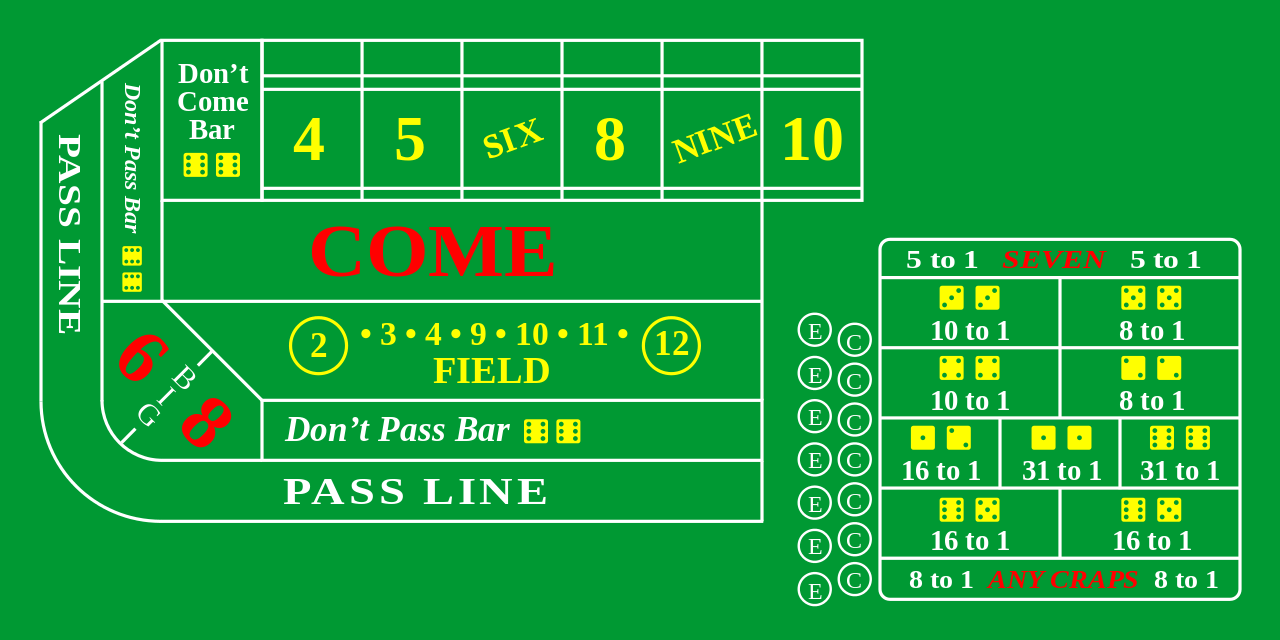
Crap tables have identical areas at each end of the table so gamblers don't have to all huddle to one side, with a section in the middle in front of one of the house staff running the game for side bets. A typical table is illustrated below:
The game has two distinct phases, which we are going to break down next, including how to bet them.
The round ends when the Point is rolled, or a 7, effectively ending that round and re-starting with the Come-Out bet. Shooters can keep the dice if they hit the Point; they pass the dice along however if they roll a 7.
It should be noted that rolling an 11 only matters on the come-out roll. If you roll an 11 after, nothing happens.
Essentially you will always place your chips on:
Pass Line / Don't Pass Line when no point is established
Come Line / Don't Come Line when a point is established
🔍 What We’ll Cover:
- How To Play
- The Come-Out Roll
- After The Come-Out Roll
- Other Bets Available
💥 How To Play
Essentially the game of craps is played by one of the gamblers at the table getting to roll the dice for a round - they will be referred to as the shooter. Their job is to throw the dice until the shooter "sevens-out" - meaning that aside from their very first roll, they keep throwing the dice until they roll a seven as this ends the round, and a new shooter takes over.Crap tables have identical areas at each end of the table so gamblers don't have to all huddle to one side, with a section in the middle in front of one of the house staff running the game for side bets. A typical table is illustrated below:
The game has two distinct phases, which we are going to break down next, including how to bet them.
- The shooter's first throw - known as the Come-Out throw
- The shooter's next throws
💥 Come-Out Throw
The first throw of the round by the shooter starts the action and can be defined by the two main bets available - the Pass Line and the Don't Pass Line. Those bets are defined as:- Pass Line - You are betting that the shooter will either hit a 7 or 11 to win immediately. If the shooter rolls a 2, 3 or 12 you lose the bet. If any other number is rolled, that becomes the Point, and must be rolled again before a 7 to win.
- Don't Pass Line - You are betting that the shooter will roll a 2 or 3 to win the bet, or a 12 to push the bet, and lose the bet on the first roll if they roll a 7 or 11. If another number is rolled, the bet is won if a 7 is rolled before the point is hit, and lose if the Point hits.
- The shooter throws a 7 on the come-out roll - all bets on the Pass line win even money; all bets on the Don't Pass Line lose
- The shooter throws a 2 on the come-out roll - all bets on the Pass Line lose; all bets on the Don't Pass Line win.
- The shooter throws a 5 on the come-out roll, making that the Point. Then they throw another 5 - the Pass Line pays out, the Don't Pass Line loses.
- The shooter throws a 10 on the come-out roll, making that the Point. They they throw an 3 (nothing happens on the Pass Line bets), and then throw a 2 (again nothing happens) before rolling a 7. The Pass Line loses, and the Don't Pass Line wins.
The round ends when the Point is rolled, or a 7, effectively ending that round and re-starting with the Come-Out bet. Shooters can keep the dice if they hit the Point; they pass the dice along however if they roll a 7.
It should be noted that rolling an 11 only matters on the come-out roll. If you roll an 11 after, nothing happens.
💥 After a Point is Established
Betting in Craps is not restricted to being in on the come-out roll. Bettors can bet on mini rounds that are referred to as Come Bets that act very similarily to Pass Bets:- Come Bet - You are betting that the shooter will either hit a 7 or 11 to win immediately. If the shooter rolls a 2, 3 or 12 you lose the bet. If any other number is rolled, that becomes the Come Point, and must be rolled again before a 7 to win.
- Don't Come Line - You are betting that the shooter will roll a 2 or 3 to win the bet, or a 12 to push the bet, and lose the bet if they roll a 7 or 11. If another number is rolled, then the shooter must roll a 7 before they roll that Come Point to pay out the bet.
- Come-out roll - shooter rolls a 5, making that the Point
- Rolls a 3 - creates a Come Point for those that bet on the Come line
- Rolls a 10 - creates a second Come Point for those that bet on the Come line
- Rolls an 12 - this pushes Don't Pass or Don't Come bets, but does not create a new Come Point or end the round
- Rolls a 3 - this pays out the Come Point bets that bet on the Come on roll 2
- Rolls a 4 - this creates another Come Point for those that bet the Come on this roll
- Rolls a 9 - this creates yet another Come point for those that bet the Come on this roll
- Rolls a 4 - this pays out Come Bets from roll 6,
- Rolls a 5 - this pays out the Pass Line bets, but all Come Points are still active & the shooter rolls a new Come-Out bet. Note - because the 12 was rolled earlier, the Don't Pass bets were pushed on roll 4, and there are no Don't Pass Bets that lose.
Essentially you will always place your chips on:
Pass Line / Don't Pass Line when no point is established
Come Line / Don't Come Line when a point is established
💥Other Bets Available
There are many other side bets available to gamblers at a craps table if they don't want to bet the Pass or Come lines, as these generally offer better than even money:- Field Bets - Bet that the next roll will not be a 5, 6, 7, or 8. If it isn't the payouts are: even money on 3, 4, 9, 10 and 11; 2 to 1 on 2 and 3 to 1 on 12.
- Hardways - Bet that the shooter will roll one of the combination of numbers shows before they roll a seven. Generally: Hard 4 or 10 pays 8 to 1; Hard 6 or 8 pays 10 to 1. Other combinations may be available with odds generally listed on the table.
- Any Seven - Bet that the next roll will be a seven, in any way - odds could vary but in this example above it pays 5 to 1
- Any Craps - Bet that the next roll will be a 2, 3 or 12 with odds of 8 to 1
- Hop Bets - Bet the exact dice roll - could be a six and three for example. These pay anywhere from 16 to 1 all the way up to 31 to 1, depending on the combination and casino. These must be verbally called out to the dealer before the roll.
🎯 Summary
Craps is one of the craziest, loudest, and most entertaining games to watch and play at the casino, but it is by far one of the most complicated to learn. The math is something we'll break down in an upcoming part to this series, but next time we'll break down some of the more advanced betting concepts in craps, and try to clarify any of the confusion you may have following what is happening at the tables, so that you are armed with the intel to tackle this great casino game on your next trip!💬 Let's Talk About It!
- If you are new to Craps - what questions do you have about the lesson above?
- If you've played before - what are your favorite betting strategies and what are things you try and avoid?
- Join the conversation here and let us know your thoughts on playing craps!
Last edited: