How to Think Like a Pro in Pot-Limit Omaha (PLO): Strategy & Mechanics

CRStals

CRStals

Moderator
Moderator

Joined
Jan 14, 2016
Total posts
11,618
Awards
19
Poker Chips
1,650
Casino Coins
236
  • #1
In the first part of our series, we went though some fundamental differences between Texas Hold’em and Pot Limit Omaha (PLO). Now in part two, we are going to dive deeper into the Mechanics of Pot-Limit Omaha (PLO). Let's get started.

Pre-Flop Play
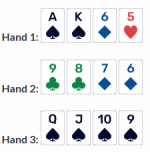
Hand selection in Omaha is critical just like it is in any other variant of poker. But you can't follow the same guidelines for pre-flop play in Omaha that you do for Texas Hold'em. For instance, pocket pairs in Pot-Limit Omaha have nowhere near the strength pre-flop as connected and suited hands do. With that in mind, let's take a look at the hands below. Which hand is stronger preflop?
1731643617740
Hand 2 is the strongest but why?
  • Multiple straight opportunities: It can make a straight from queen high, all the way down to 7 high: six total possible straights
  • Double suited: Being double suited (holding two different suits, and only two suits) gives it the ability to make a club or diamond flush. Since you have two cards of each suit, you don’t block your ability to hit one flush or the other.
  • No pocket pairs: Avoiding pairs gives you more opportunities to get two pairs or a full house with any combination of your hole cards: again, rarely does one pair or a high kicker ever win at showdown in Omaha.
Why does Hand 3 look good, but is nowhere near as good as the middle hand?
  • Less straight options: You have a lot of options to hit a straight being fully connected, but you can only make five possible straights, unlike the middle hand's six possible. You can make an ace high, king high, queen high, jack high and ten high straights; you can’t make a 9 high because you must use two hole cards.
  • Smaller flush opportunities: You are less likely to hit a flush because you only have spades, but compounding that is you hold two spades that you cannot use, thus reducing your odds of getting there in the end with only nice usable spades left in the deck.
  • Pairs and full house potentials: You can hit two pairs and full houses just like the middle hand, but remember - hitting top pair in Omaha is very rarely going to be enough to win.
What makes the Hand 1 more difficult to play?
  • Less draw capabilities: For starters, you only have one combination that is powerful to play pre-flop: 1731643641256
  • AK can only make an ace high straight, while the 56 can hit anything from a nine high to a six high: five straights in total. This is not as many as the middle hand, again, restricting the ability to win the pot post flop by the cards that could come.
  • Fewer flush possibilities: You can only hit a spade flush (we aren’t blocking our odds to doing so), or hope to hit two pairs or full houses.
In Pot-Limit Omaha, subtle differences like that could greatly impact your profitability by playing the wrong hands consistently. However, unlike Hold’em, you cannot rely on pre-flop odds because most hands pre-flop are too close in equity.

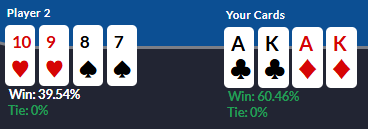
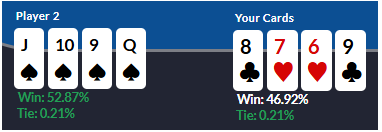
Let's break this down - lets say we have two hands heads-up - AAKK double suited, and T987 double suited in the other two suits. Heads-up the odds look like this:
1732237775618
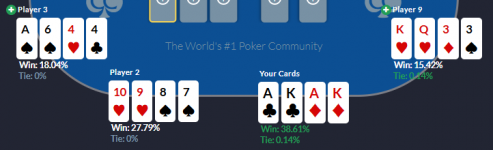
The double paired hand has a sizable equity advantage. However, let's add two other random hands into the mix:
1732237842088
Notice how the connected & suited hand's equity dropped 11.75% while the AAKK double suited hand dropped 21.85% - almost double the connected hand, even with only having 2 flush outs taken? Having options post flop in PLO is going to lead to more equity, especially with more hands in play pre-flop.

Let’s go back to those three hands to illustrate this point even more. Below are four examples – one with the three hands together and then three scenarios with two hands pitted against each other:

Hand #1
1731542506555


Hand #2
1731542553169


Hand #3
1731542677948


Hand #4
1731542759873


What is the first thing you notice? The more hands in play, the better connected and double suited hands play but heads-up, the better bigger cards play pre flop. Some pointed out that there are PLO hand rankings out there but there are reasons why hand rankings in PLO are much more volatile to follow. What do we mean by that? Well, the margins are a lot closer. Here are some examples:
  • AAKK double suited is a 60% favorite against a hand like 9876 double suited – it’s slightly better than a coin flip.
  • 9876 double suited is a 58% favorite against a hand like T642 double suited – the odds are marginally closer to a coin flip.
  • AAKK double suited only improves to a 63% favorite against a hand like T642 double suited.
  • AAKK double suited is a 70% favorite against a hand like QT53 all one suit – or all four suits.
In Pot Limit Omaha, hands that don’t look playable at first glance have substantially more equity than you would think even against the more powerful hands possible. Heads up it would be rare to be anything less than a 30% favorite pre-flop regardless of what you or your opponent are holding, and often it will be more of a coin flip than you might think.

Don’t take this the wrong way – this is not a call to be more active pre-flop in Omaha. In fact, this is a call to be more patient and aware pre-flop because with every hand that enters the pot, your equities will all move closer together. It’s the flop that will really set the stage for who has the best chance to win the hand.


Post Flop
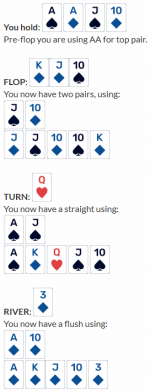
One of the unique aspects of PLO is the hand strength changing street to street because the hole cards you use to make your best 5-card hand can (and often do) change. Here’s an example of your hole cards changing street to street to illustrate this point:

1731643572722

As you can see, being focused on just two-hole cards in PLO is short sighted because of the possibilities your hand could have later in the pot. These additional hand possibilities can have a big impact on your decisions earlier in the hand when it comes to implied odds.

What are Implied Odds?
Implied odds is the ratio of the possible or likely amount we will win relative to the cost of calling. And while we may not be able to exactly pinpoint how much we might win, PLO gives one advantage that Hold’em can’t: betting pot.

In PLO, we know the maximum that any player can bet at any given point in the hand: the size of the pot. This ceiling restricts the amount a player can technically lose if they decide to simply call and not raise to showdown, which can make calculating implied odds much easier for both players. A player may not want to call off their entire stack but, might call pot sized bets to showdown. Depending on the type of player you are against in a hand, this cap can prove to be a blessing or a hindrance, by letting players call down knowing what they have to invest to try and get there by showdown. Those that like to try and get there will often call and this can be difficult to combat knowing that they will not have to go broke in a hand to try and hit one of their outs.

In short, Pot Limit Omaha is a poker game where the action changes on every street and the betting is typically more intense than in Hold’em even though you can only bet pot.

Next week get ready for lesson #3: Pot-Limit Omaha Hi/Lo Unpacked


This has been a part of our CardsChat Learning Poker Thread Series. Be sure to check out and subscribe to our CardsChat Learning Poker Thread Series Index so you don't miss a new series or chapter!

87a15cf88098d189c35ee2b4b725d9bb.png
 

Attachments

  • 1731643667695.png
    1731643667695.png
    9.1 KB · Views: 9
  • 1731643804469.png
    1731643804469.png
    8.2 KB · Views: 23
Last edited:
  • Like
  • Love
Reactions: Brigistul, tagece, Vallet and 5 others
MK_

MK_

Legend
Loyaler
Joined
Sep 14, 2022
Total posts
2,843
Poker Chips
1,352
Casino Coins
10
  • #2
The heck?.... how did I miss this... , nice post👍
Bump
 
  • Like
  • Love
Reactions: CRStals, hutzpaf, pirateglenn and 1 other person
mattiebumpo

mattiebumpo

Legend
Loyaler
Joined
Aug 24, 2021
Total posts
6,127
Awards
10
US
Poker Chips
3,070
Casino Coins
0
  • #3
Wow! Thank you for the lesson! Now I need to find part 1!
 
  • Like
Reactions: pirateglenn
Tammy

Tammy

I'm Here to Help
Administrator
Joined
May 18, 2005
Total posts
63,783
Awards
14
US
Poker Chips
2,463
Casino Coins
20
  • #4
  • Like
Reactions: pirateglenn and mattiebumpo
pirateglenn

pirateglenn

Legend
Loyaler
Joined
Apr 17, 2018
Total posts
4,418
Awards
5
GB
Poker Chips
235
Casino Coins
0
  • #5
This is a fantastic post and a great learning resource - thank you CRStals/Tammy - im in and subscribed!
 
  • Like
Reactions: CRStals and Tammy
Gutshot Gus

Gutshot Gus

Legend
Platinum Level
Joined
Oct 15, 2021
Total posts
1,275
Awards
7
Poker Chips
428
Casino Coins
0
  • #6
I play a lot of Gin and that background seems to help in playing Omaha.
Both games you want to have cards that connect and work together.
For me the main thing is having discipline to play strong hands and stay away from hands with danglers.
In Omaha much more than Holdem you have to realize that you can play correct and still lose.
This is a good series and I hope that in the future it will grow and expand.
 
  • Like
Reactions: Vallet, pirateglenn and Tammy
Tero

Tero

Legend
Loyaler
Joined
Dec 31, 2019
Total posts
3,228
Awards
2
FI
Poker Chips
3,569
Casino Coins
220
  • #7
I appreciate your effort but when I look around to find PLO learning tools I only find that there aren't that many available.
That alone is kinda discouraging.
 
MK_

MK_

Legend
Loyaler
Joined
Sep 14, 2022
Total posts
2,843
Poker Chips
1,352
Casino Coins
10
  • #8
I think Phil Galfond is always a good place to start for anything Omaha related👍
 
  • Like
Reactions: pirateglenn, sibkaz and Tammy
eetenor

eetenor

Legend
Loyaler
Joined
Mar 5, 2019
Total posts
2,801
Awards
2
Poker Chips
638
Casino Coins
0
  • #9
CRStals said:
In the first part of our series, we went though some fundamental differences between Texas Hold’em and Pot Limit Omaha (PLO). Now in part two, we are going to dive deeper into the Mechanics of Pot-Limit Omaha (PLO). Let's get started.

Pre-Flop Play
Hand selection in Omaha is critical just like it is in any other variant of poker. But you can't follow the same guidelines for pre-flop play in Omaha that you do for Texas Hold'em. For instance, pocket pairs in Pot-Limit Omaha have nowhere near the strength pre-flop as connected and suited hands do. With that in mind, let's take a look at the hands below. Which hand is stronger preflop?
View attachment 372912
Hand 2 is the strongest but why?
  • Multiple straight opportunities: It can make a straight from queen high, all the way down to 7 high: six total possible straights
  • Double suited: Being double suited (holding two different suits, and only two suits) gives it the ability to make a club or diamond flush. Since you have two cards of each suit, you don’t block your ability to hit one flush or the other.
  • No pocket pairs: Avoiding pairs gives you more opportunities to get two pairs or a full house with any combination of your hole cards: again, rarely does one pair or a high kicker ever win at showdown in Omaha.
Why does Hand 3 look good, but is nowhere near as good as the middle hand?
  • Less straight options: You have a lot of options to hit a straight being fully connected, but you can only make five possible straights, unlike the middle hand's six possible. You can make an ace high, king high, queen high, jack high and ten high straights; you can’t make a 9 high because you must use two hole cards.
  • Smaller flush opportunities: You are less likely to hit a flush because you only have spades, but compounding that is you hold two spades that you cannot use, thus reducing your odds of getting there in the end with only nice usable spades left in the deck.
  • Pairs and full house potentials: You can hit two pairs and full houses just like the middle hand, but remember - hitting top pair in Omaha is very rarely going to be enough to win.
What makes the Hand 1 more difficult to play?
  • Less draw capabilities: For starters, you only have one combination that is powerful to play pre-flop: View attachment 372913
  • AK can only make an ace high straight, while the 56 can hit anything from a nine high to a six high: five straights in total. This is not as many as the middle hand, again, restricting the ability to win the pot post flop by the cards that could come.
  • Fewer flush possibilities: You can only hit a spade flush (we aren’t blocking our odds to doing so), or hope to hit two pairs or full houses.
In Pot-Limit Omaha, subtle differences like that could greatly impact your profitability by playing the wrong hands consistently. However, unlike Hold’em, you cannot rely on pre-flop odds because most hands pre-flop are too close in equity.

Let’s go back to those three hands to illustrate that point. Below are four examples – one with the three hands together and then three scenarios with two hands pitted against each other:

Hand #1
1731542506555


Hand #2
1731542553169


Hand #3
1731542677948


Hand #4
1731542759873


What is the first thing you notice? The more hands in play, the better connected and double suited hands play but heads-up, the better bigger cards play pre flop. Some pointed out that there are PLO hand rankings out there but there are reasons why hand rankings in PLO are much more volatile to follow. What do we mean by that? Well, the margins are a lot closer. Here are some examples:
  • AAKK double suited is a 60% favorite against a hand like 9876 double suited – it’s slightly better than a coin flip.
  • 9876 double suited is a 58% favorite against a hand like T642 double suited – the odds are marginally closer to a coin flip.
  • AAKK double suited only improves to a 63% favorite against a hand like T642 double suited.
  • AAKK double suited is a 70% favorite against a hand like QT53 all one suit – or all four suits.
In Pot Limit Omaha, hands that don’t look playable at first glance have substantially more equity than you would think even against the more powerful hands possible. Heads up it would be rare to be anything less than a 30% favorite pre-flop regardless of what you or your opponent are holding, and often it will be more of a coin flip than you might think.

Don’t take this the wrong way – this is not a call to be more active pre-flop in Omaha. In fact, this is a call to be more patient and aware pre-flop because with every hand that enters the pot, your equities will all move closer together. It’s the flop that will really set the stage for who has the best chance to win the hand.


Post Flop
One of the unique aspects of PLO is the hand strength changing street to street because the hole cards you use to make your best 5-card hand can (and often do) change. Here’s an example of your hole cards changing street to street to illustrate this point:

View attachment 372911

As you can see, being focused on just two-hole cards in PLO is short sighted because of the possibilities your hand could have later in the pot. These additional hand possibilities can have a big impact on your decisions earlier in the hand when it comes to implied odds.

What are Implied Odds?
Implied odds is the ratio of the possible or likely amount we will win relative to the cost of calling. And while we may not be able to exactly pinpoint how much we might win, PLO gives one advantage that Hold’em can’t: betting pot.

In PLO, we know the maximum that any player can bet at any given point in the hand: the size of the pot. This ceiling restricts the amount a player can technically lose if they decide to simply call and not raise to showdown, which can make calculating implied odds much easier for both players. A player may not want to call off their entire stack but, might call pot sized bets to showdown. Depending on the type of player you are against in a hand, this cap can prove to be a blessing or a hindrance, by letting players call down knowing what they have to invest to try and get there by showdown. Those that like to try and get there will often call and this can be difficult to combat knowing that they will not have to go broke in a hand to try and hit one of their outs.

In short, Pot Limit Omaha is a poker game where the action changes on every street and the betting is typically more intense than in Hold’em even though you can only bet pot.

Next week get ready for lesson #3: Pot-Limit Omaha Hi/Lo Unpacked


This has been a part of our CardsChat Learning Poker Thread Series. Be sure to check out and subscribe to our CardsChat Learning Poker Thread Series Index so you don't miss a new series or chapter!

87a15cf88098d189c35ee2b4b725d9bb.png
I have an issue with your first statement being unclear for new plo players you state-
For instance, pocket pairs in Pot-Limit Omaha have nowhere near the strength pre-flop as connected and suited hands do. With that in mind, let's take a look at the hands below. Which hand is stronger preflop?
1731643617740


If you make the initial statement of pairs vs suited connected hands then you need a pair hand in the example and that pair hand needs to be 99 33 rainbow 22% EQ etc to clarify your point ---QdQh4s4c rainbow has 37% equity vs 2 and 3 KK44 rainbow has 36% --KK43 rainbow has only 31% EQ it too would be a good example for what your initial statement implies

So your hand example AK65 is not a pocket pair preflop and hand 3 blocks a lot of outs of hand 1 in order for the rundown hand 2 to be the best hand preflop.:unsure::geek:

the complexity of PLO requires us to be very succinct in our examples for beginning strategies
 
  • Like
Reactions: Vallet and pirateglenn
CRStals

CRStals

Moderator
Moderator

Joined
Jan 14, 2016
Total posts
11,618
Awards
19
Poker Chips
1,650
Casino Coins
236
  • #10
eetenor said:
I have an issue with your first statement being unclear for new plo players you state-
For instance, pocket pairs in Pot-Limit Omaha have nowhere near the strength pre-flop as connected and suited hands do. With that in mind, let's take a look at the hands below. Which hand is stronger preflop?
1731643617740


If you make the initial statement of pairs vs suited connected hands then you need a pair hand in the example and that pair hand needs to be 99 33 rainbow 22% EQ etc to clarify your point ---QdQh4s4c rainbow has 37% equity vs 2 and 3 KK44 rainbow has 36% --KK43 rainbow has only 31% EQ it too would be a good example for what your initial statement implies

So your hand example AK65 is not a pocket pair preflop and hand 3 blocks a lot of outs of hand 1 in order for the rundown hand 2 to be the best hand preflop.:unsure::geek:

the complexity of PLO requires us to be very succinct in our examples for beginning strategies
Totally vaid point and thanks for pointing it out - I added a bit more to the section to illustrate what happens to a double paired and double suited hand against a connected and suited hand, and when a few more hands enter in. But your point about PLO being a complex game is 100% valid
 
  • Like
Reactions: Brigistul, Ketoupitou, eetenor and 2 others
Vallet

Vallet

Legend
Loyaler
Joined
Jun 5, 2019
Total posts
2,351
Awards
14
Poker Chips
608
Casino Coins
0
  • #11
Changing hand strength from street to street in Omaha makes us think about the odds more often. Time bank will never be superfluous. I like the pot-limit format.
 
  • Like
Reactions: CRStals and Tammy
tagece

tagece

Legend
Loyaler
Joined
Sep 14, 2015
Total posts
2,209
Awards
3
BR
Poker Chips
800
Casino Coins
0
  • #12
I always thought PLO was a fun game, although I never played it well. Now I see that the game has even more variations than I imagined.
 
  • Like
Reactions: CRStals
Flyer35

Flyer35

Per Ardua ad Astra
Loyaler
Joined
May 11, 2024
Total posts
3,391
Awards
4
CA
Poker Chips
1,059
Casino Coins
0
  • #13
Oops - something went wrong with your images . This is what I'm seeing:

----------------------------------------------

Screenshot 2025 08 16 at 25300PM

----------------------------------------------

I'd like to comment further, but would need to see what these images were first.
 
Last edited:
Flyer35

Flyer35

Per Ardua ad Astra
Loyaler
Joined
May 11, 2024
Total posts
3,391
Awards
4
CA
Poker Chips
1,059
Casino Coins
0
  • #14
CRStals said:
1731643617740

Hand 2 is the strongest but why?
This seems to apply more in an all-in pre-flop scenario than when a hand is actually played out. Obviously that's not going to happen often in a pot limit game, and shouldn't happen often in a no limit game.

While Hand 2 may theoretically be the strongest, I don't think it wins much. Most people are going to favour hands 1 and 3 hoping for a higher flop. When the flop comes low/medium they are going to fold their hands to any kind of significant action. So hand 2 may make the straight, but there's not going to be anybody around to pay it off. Same thing applies to flushes. Any flush that hand 2 makes is going to be at risk from higher flushes (which given that each player has 4 holes cards, is very likely). If hand 2 makes a flush (or straight) and nobody has a better one, nobody will put much in the pot UNLESS they have a full house (or draw), which also happens a lot. The exception are straight flushes which we see more often in PLO.

Middle of the road straights and flushes may make the holder feel good when they win, but I'm usually only staying in if I have a better hand. I fold lower flushes and straights all the time in PLO when the action tells me that somebody has the higher straight or flush. And I'm not an overly cautious player. I've seen enough of these hands revealed to know that it just is what it is.
 
Last edited:
  • Like
Reactions: Brigistul and CRStals
CRStals

CRStals

Moderator
Moderator
Joined
Jan 14, 2016
Total posts
11,618
Awards
19
Poker Chips
1,650
Casino Coins
236
  • #15
Flyer35 said:
Oops - something went wrong with your images . This is what I'm seeing:

----------------------------------------------

View attachment 390363

----------------------------------------------

I'd like to comment further, but would need to see what these images were first.
Some of these images worked fine in draft but didn't copy into the forum - we did figure out why so if they aren't showing for you we can try and re-post
 
Top