AviCKter said:
But just for argument shake, let's see what happens when we change his range.
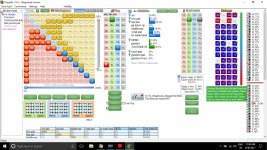
Eg. BB Defense range: {22-55, 66-77(3-bets 1/2 the time, flats the other half), A2s-A7s, A2o-A9o, K6s-KTs, K8o-KJo, Q8s-QJs, Q9o-QJo, J8s-JTs, J9o-JTo, T8s-T9s, T8o-T9o, 97s-98s, 98o, 86s-87s, 87o, 75s-76s, 76o, 65s, 54s}
BB 3-bet range: {88-AA, 66-77(3-bets 1/2 the time, flats the other half), A8s-AKs, ATo-AKo, KJs-KQs, KQo}
Now the analysis turns its table, because
EVcheck = 0.64*6.5 = +4.16
EVbet = 0.39*6.5+(0.33*(10.5*0.85-4*0.15))-(0.28*(4*0.92-0.08*10.5))
=2.535+(0.33*8.325)-(0.28*2.84)
EVbet=+$4.4771
In this case, betting the flop would be more profitable than checking.
- EVcheck = 0.639 * 6.5 = +4.15
EVbet =
- Folds: 0.328 * 6.5 = 2.132
- Worse Hands: 0.388 * (14.5 * 0.811 - 4) = 0.388 * (7.7595) = 3.01
- Better Hands: 0.284 * (14.5 * 0.0873 - 4) = 0.284 * (-2.7342) = -0.776
- = +4.366
This range had 237 combinations, and we're 64% against it. Like you said. 90/317 are better: 28.4% (8.7%), 123/317 are worse pair or open ended draw: 38.8% (16 are open-enders, which I assume we keep 81.1% if we do and 83.4% if we don't), 104/317 fold: 32.8% (100%)
I reran these numbers, but in this case we do end up with more
equity from betting. But, we've removed a lot of his A-x combinations and included more bad pairs that he is calling with. We could get even better, if we remove all A-x
hands and have his call with any pair and any draw. But, these sort of range constructions and assumptions are pretty wild.
And, as you can see ranging the Villain might be the key to the problem. If we can properly range him, I guess the analysis would be different and we might draw to a better conclusion.
I'm pointing this out, because I had done this analysis before and betting the flop dominated checking. i.e. 2nd pair like holding KQo in a AK3 board or QJ in a KJ2 board, you have to bet the flop (Assuming the board doesn't have flush draw to it, the analysis changes with that).
Like I said, I think your range here is unrealistic. It's basically assuming that he holds very few hands that beat you, and calls very wide with hands you can beat. How many people are really calling with worse than third pair? Of these players, how many are 3-betting A8s? If they're passive calling stations who will call down with horrible pairs, it seems much more likely that they are equally passive pre-flop and will be calling most or all of their A-x hands. And, those players who know that A-x is a good 3-bet (A6 - A9 are great for many reasons), might also be prone to check-raise
bluffing some of these flops with hands that miss.
There are some players who are aggressive pre-flop (and an 11% 3-bet is a pretty aggressive player) but passive post-flop, but they are as rare as unicorns.
In my opinion you should bet your entire range there (In the context, playing against a BB defense).
This is a different post, but this is also a bad idea. Your opening range has way too much air on that board to c-bet 100%. An observant player could check-raise you with reckless impunity if you c-bet 100% of your range. Something like 40-50% of your range is pure air on this flop, and only 28% of your range is top pair or better (plus some of those top pairs are stuff like A-2 where you should be folding).
If you are only c-betting pairs or better, your flop checking range is wide enough and weak enough that your opponent can call the BB 100% of the time, check the flop, and play you perfectly (folding to your bets with air and betting all the turns to pick up the pots you miss). They will show a profit doing this, even with 100% of their hands.
What you need is a balanced betting and checking range, one where each category contains value and air. You will be checking the majority of your complete misses and some of your value hands. You will be betting many of your value hands for value, as well as some of your [complete air] as bluffs. The value hands in your checking range protects your checks, so the BB can't just bet all the turns after you check. The air in your betting range gives value to your bets, because the BB can't just fold everything that doesn't beat middle pair.