
Poker Hands & Poker Hand Rankings Chart
 Reviewed by WSOP Winner Chris ‘Fox’ Wallace
 Beginner-friendly
 1 minute read
Poker hands fall into one of 10 categories. The highest is a royal flush, followed by a straight flush, then four of a kind, a full house, a flush, a straight, three of a kind, two pair, one pair, and finally a high card. This is the same for all the most popular 52-card standard poker variations, including Texas Hold’em, Omaha, and Seven-Card Stud.
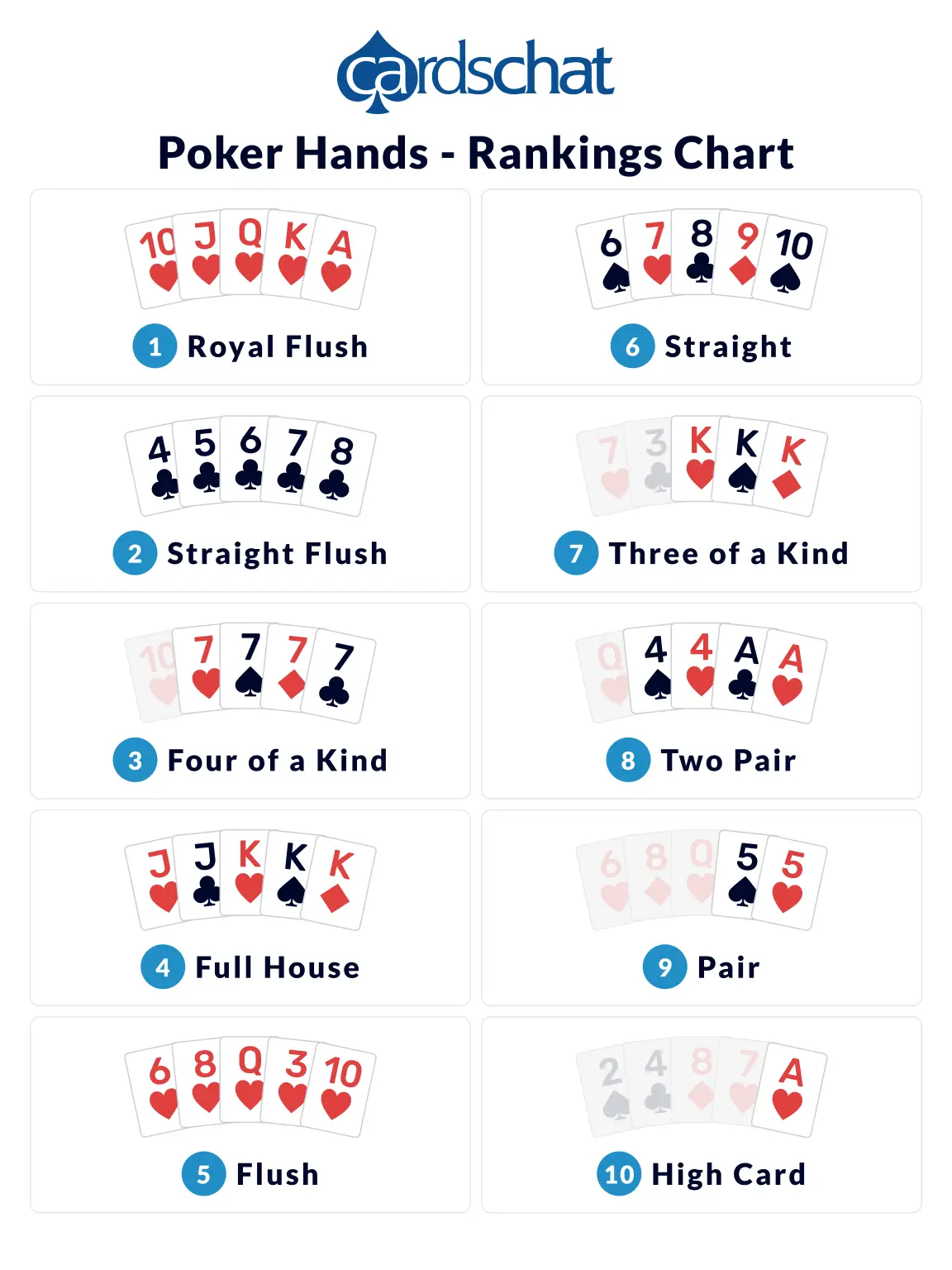

Download and print out our poker hands ranking chart, or save it to your phone. Keep this poker cheat sheet nearby when playing so that you always know the ranking of hands from best to worst.
Poker hands ranking chart
| Rank | Hand Name | Example | Odds Against | Combinations | Description |
|---|---|---|---|---|---|
| 1 | Royal Flush | 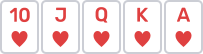 | Probability 30,939 to 1 | Combinations 4 | A Royal Flush is made out of 10, Jack, Queen, King, Ace, all of the same suit. |
| 2 | Straight Flush | 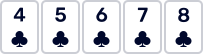 | Probability 3,437.8 to 1 | Combinations 36 | A Straight Flush is five cards in a row, all in the same suit. |
| 3 | Four of a Kind | 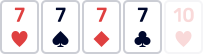 | Probability 594 to 1 | Combinations 624 | Four of a Kind is the same card in each of the four suits. |
| 4 | Full House |  | Probability 37.5 to 1 | Combinations 3,744 | A Full House is a pair plus three of a kind in the same hand. |
| 5 | Flush | 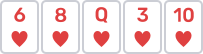 | Probability 32.1 to 1 | Combinations 5,108 | A Flush is five cards in the same suit, not in numerical order. |
| 6 | Straight | 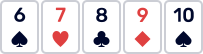 | Probability 20.6 to 1 | Combinations 10,200 | A Straight is five cards in numerical order, but not in the same suit. |
| 7 | Three of a Kind |  | Probability 19.7 to 1 | Combinations 54,912 | Three of a Kind is three of one card and two non-paired cards. |
| 8 | Two Pair |  | Probability 3.26 to 1 | Combinations 123,552 | Two Pair is two different pairings of the same card in one hand. |
| 9 | One Pair | 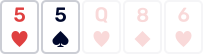 | Probability 1.28 to 1 | Combinations 1,098,240 | One Pair is a pairing of the same card. |
| 10 | High Card |  | Probability 4.74 to 1 | Combinations 1,302,540 | A High Card refers to a hand with no matching cards. |
Understanding hand rankings is your first step on the road to becoming a winning poker player. Knowing the best hands will help you win more, beat your friends at home, and become a better player


Video tutorial: Poker Hand Rankings
Video tutorial: poker hand rankings
Poker Hands Explained
With 10 diverse hands available in most versions of poker, it’s imperative players understand how to identify and play each hand. Here’s an overview of poker hands with examples, their ranking, and how to play them.
Royal Flush
The royal flush is the strongest of all poker hands. It wins over all other combinations and guarantees success when going to a showdown. It is also known as the ‘absolute nuts’ since it cannot be beaten.
It consists of Ten, Jack, Queen, King, Ace, all of the same suit. There are four royal flush combinations in poker:
- A
 , K, Q, J, 10
 - A
 , K, Q, J, 10
 - A
 , K, Q, J, 10
 - A
 , K, Q, J, 10
A royal flush is exceedingly rare – the odds of getting a royal flush on the flop are 1/649,739 (0.000154%).
Scoring a royal flush is a dream come true as no other hand can top it. The skill is to lure other players into increasing the pot, thereby maximizing your winnings from the hand.
Straight Flush
A straight flush ranks as the one of the top winning poker hands. In fact, a straight flush can only be beaten by a stronger straight flush (such as the rare royal flush).
It consists of five cards of the same suit in consecutive rank. There are 36 variations of a straight flush (excluding royal flushes), including:
- K, Q, J, 10, 9
- 9, 8, 7, 6, 5
- Q, J, 10, 9, 8
- 5, 4, 3, 2, A
While not as rare as a royal flush, hitting a straight flush on the flop is uncommon – the odds are 1/72,192 (0.00139%).
Although a straight flush often wins, it can be beaten by a higher-ranking straight flush. Try to lure other players to build the pot, but be cautious if you are relying on the board cards as another player may hold a higher-ranking hand.
Four of a Kind
While not as strong as a straight flush, scoring ‘quads’ is a great feeling as it’s one of the top hands in poker.
Four of a kind consists of four cards of the same rank plus a fifth card which can be of any rank. Some examples of quads include:
- A, A, A, A, 5
- J, J, J, J, 9
- 7, 7, 7, 7, K
- 4, 4, 4, 4, 10
While four of a kind is not as rare as a straight flush, it’s still a lucky moment when you score one. The odds of getting quads are 1/4,165 (0.0240%).
While four of a kind is a strong hand, its strength depends on which four cards you hold – naturally, four Kings are stronger than four Twos. If two players have four of a kind of the same rank, the winner will be decided by the fifth card, the ‘kicker’.
Full House
A full house combines three of a kind and a pair into one of the strongest hands in poker. Although it’s stronger than most hands, its strength is primarily dictated by the three of a kind.
Combining a three of a kind (three cards of the same rank) plus a pair (two cards of the same rank), a full house is a strong hand which can be constructed in many ways, such as:
- A, A, A, Q, Q
- J, J, J, 2, 2
- 10, 10, 10, A, A
- 4, 4, 4, K, K
Being dealt a full house on the flop is unusual, normally you might hit the three of a kind or pair on the flop before getting the remaining card(s) on the turn and/or river. The odds of getting a full house on the flop are about 1/693 (0.1441%).
While a full house is strong, be aware that it can be beaten by a similar hand with a higher three of a kind. How you play a full house depends on how many people are in the hand and how strong you suspect their hands to be. If you’re confident you have the best hand, you don’t want to scare players out of the pot by betting too aggressively.
Flush
In terms of poker hand rankings, a flush ranks somewhere in the middle. While stronger than hands such as three of a kind, it can be beaten by stronger hands, including a straight flush.
A flush consists of five cards of the same suit. Unlike a straight flush, the cards do not have to be in order of ranking. Some examples of a flush include:
- A, Q, 10, 7, 4
- J, 9, 8, 4, 3
- 10, 7, 4, 3, 2
- 8, 7, 5, 4, 3
Flushes are relatively common as there are more than 5,000 different possibilities. The odds of hitting a flush on the flop are about 1/508 (0.1965%).
Playing a flush can be tricky. You should only stay in the hand if you have the right odds to call any bets and if you’re confident that you have the strongest hand. While you should be careful if pairs are present on the board, in most cases your main concern should be another player holding a stronger flush.
Straight
Simple to understand, a straight is a useful hand which ranks in the middle of poker hand rankings. It’s weaker than a flush, but stronger than three of a kind. The relative strength of a straight relies on the highest card in the sequence.
A straight consists of five cards in sequential order of any suit. Examples of a straight include:
- A, K, Q, J, 10
- Q, J, 10, 9, 8
- 7, 6, 5, 4, 3
- 5, 4,3, 2, A
There are more than 10,000 ways to form a straight. The odds of scoring one on the flop are about 1/253 (0.3925%).
There are two dangers to be aware of when playing straights – flushes and higher straights. If the board consists of three cards of the same suit, a flush is likely and you may already be beaten. Likewise, be wary of holding the ‘low end’ of a straight. If you have Eight-Nine on a board of Ten-Jack-Queen, you may lose to opponents with Ace-King or Nine-King.
Three of a Kind
On the weaker side of the ranking, three of a kind is stronger than two pair but weaker than a flush or straight. Like four of a kind, the relative strength of this hand is determined by the rank of the cards: for example, three Nines will outrank three Sevens.
Three of a kind is one of the easiest poker hands to understand for beginners. It consists of three cards of the same rank, such as:
- A, A, A, J, 4
- Q, Q, Q, A, 8
- 9, 9, 9, K, 7
- 2, 2, 2, J, 10
With more than 54,000 possibilities, hitting three of a kind is relatively common. The odds of scoring three of a kind on the flop are about 1/46 (2.1128%).
If you hit three of a kind on the flop, you can proceed with confidence as it could lead to a full house. If you don’t have the cards for a full house, watch out for potential straights or flushes that could beat your hand.
Two Pair
Two pair is one of the most frequent winning hands in poker. In addition to being weaker than most other hands, it occurs far more commonly so you’re more likely to see it in regular play as there are more than 120,000 ways to make the hand.
As the name suggests, two pair consists of two sets of two cards with the same rank. Examples of two pairs hands include:
- A, A, Q, Q, 5
- J, J, 8, 8, A
- 9, 9, 5, 5, K
- 6, 6, 2, 2, 10
The odds of scoring two pair on the flop are relatively high at 1/20 (4.7539%).
This makes it a common hand in regular play. While two pair gives you a good opportunity to win, it does come with certain pitfalls. Although it is one of the most common ways to win, it can easily be beaten by a three of a kind. The main thing to watch out for is losing to a higher two pair if the cards don’t fall your way on the river.
One Pair
The most common combination of hands in poker, accounting for around half of all poker hands, there are more than 1 million ways to make a pair.
Naturally, a pair, consisting of two cards of equal rank, is weaker than two pair. In fact, one pair is the weakest hand in poker barring high card. Some one pair hands include:
- A, A, J, 7, 4
- Q, Q, K, 10, 2
- 8, 8, A, J, 9
- 2, 2, 10, 8, 4
You have an almost 50-50 chance of scoring one pair on the flop. The odds are 1/1.366 (42.2569%).
Playing one pair is tricky and depends on factors including the value of the pair, stage of the hand, state of the board, and more. Any pair has the potential to make a three of a kind, so it can be worthwhile to see a flop, ifit’s not too expensive to do so. Ultimately, remember that one pair is not a strong hand and you can never have full confidence that you’re ahead.
High Card
The weakest hand in poker, high card will be beaten by any other hand listed above. The only hand that a high card can beat is a weaker high card.
High card is a five-card hand of different rank, suit, and not sequential order. The value of the hand is based on the highest-ranking card: Ace-high is the strongest high card while Seven-high is the weakest. Examples of a high card hand include:
- A, Q, 9, 5, 3
- K, 7, 5, 4, 2
- J, 10, 7, 6, 2
- 9, 8, 7, 6, 4
The odds of getting high card on the flop are 1/0.995 (50.1177%).
Winning with a high card is rare in poker. In our experience, this only happens in the unlikely event that no player holds a stronger hand. Alternatively, skilled players may be able to bluff their way to victory. In that instance, remember:it’s the bluff that wins the pot, not the hand.
Ties and kickers
It’s possible that the best hand at the table will be held by more than one player. To resolve this, if possible, the winning hand will be determined by the ranking of the cards. For example, if two players hold a full house, the winning hand will be decided by the hand with the higher ranking three of a kind.
In hands where this is not possible, such as two players both holding four of a kind, the tie is broken using a ‘kicker’ – the next highest card in the hand.
For example, a player holding a pair of Nines with a King, Eight and Five, would beat a player with a pair of Nines alongside a Jack, Eight, and Five. If kickers are also tied, the next highest card decides the winner, and if all cards are tied the pot is evenly split between the winning players.
Poker guides
Once you have mastered poker hands, check out our other guides to help you become a better player.


Looking to level up your Poker Skills further?