C-betting with missed hands

Mohamedkolea

Mohamedkolea

Enthusiast
Silver Level
Joined
May 13, 2026
Total posts
34
DZ
Poker Chips
84
Casino Coins
0
  • #1
How and when to continuation-bet with cards like AK or AQ when they miss the flop ? I Always fold its bad idea ?
 
B

bleble2be

Enthusiast
Silver Level
Joined
Aug 11, 2026
Total posts
30
NO
Poker Chips
37
Casino Coins
0
  • #2
i play them if the flop cards are lower and the bets are low
 
  • Like
Reactions: Mohamedkolea
S

Semprini

Rock Star
Bronze Level
Joined
Jun 26, 2026
Total posts
233
CA
Poker Chips
98
Casino Coins
0
  • #3
C-betting a whiffed flop as PRF in position when checked to is EXTREMELY profitable. If you're not doing it, start. Like right now. Especially if you have AK because if you get called you still have 6 outs to improve to top-pair-top-kicker.

You want to be the pre-flop aggressor and you want to have position post flop. C-betting doesn't work nearly as well when you are out of position. This is one of the main reasons why we can open quite wide from the CO and BT pre-flop but stay tight in middle and early positions.

You want to have only 1 or 2 Villains in the hand and you want them both to check to you. C-bet bluffing gets dangerous when there are too many opponents that might fluke hit something. When players check the flop out of position, roughly 90% of the time they have nothing and roughly 10% of the time they are slow playing a strong hand, so 90% of the time, they are ready to fold to aggression.

You want to check back sometimes too to keep them guessing. If you c-bet flops with 100% frequency,after the 3rd or 4th or 5th time, a lot of players will get suspicious and start to call or raise you to test you out, or they will check to trap you when they flop 2-pair knowing that you will bet into them. Minimum you should be c-bet bluffing 50% of the time. I do it with 60-80% frequency depending on stacks and opponents' tendencies. The smaller their stacks and the more nitty/foldy they are I will c-bet more.

You want to check back on very wet boards. Say 789 with 2 hearts or K68 monotone clubs. These are not good flops and the risk is too high for bluffing so just stay away.

However, very few flops are truly dry so mildly wet boards are still okay. If you bluff a wet flop and get called, often the best thing to do is CONTINUE AGAIN on the turn. Why? Because Villain is chasing a draw. If he's chasing a draw he has nothing (until it completes). So watch the board. If the flop is KJ4 with 2 diamonds, he checks, we bet 40%, he calls. The turn is 5 hearts. He still has a draw, so he checks, we bet 40% and he calls. The river is the 4 of spades. He doesn't have trips because he's not calling these barrels with a 4. There is no 3rd diamond and there is no 3rd card to connect the K and J (no Q, no T, no A, not even a 9). So he has busted. He checks. We bet half-pot. He folds. We get 2 streets of value out of him and neither of us had anything! <-- We make a LOT of money doing this.

If we open J9s - flops with an A or a K on them make great bluffs. Villain limp-called our strong late position open and checked because he's afraid that we have an A or a K on this flop. He's usually ready to fold. As the PFR we have more A and K in our range than a limp-caller or a defender on the blinds.

Paired flops are the best! Nothing makes people fold more than a pair on the board. When I first learned this I could not believe it. Really? You bet and they all just run away? YES!! You see, on a flop like T73 there are 9 outs to hit it: three Ts + three 7s + three 3s = 9. On a T77 flop, there are only FIVE outs to hit it: three Ts + two 7s = 5, so the chances that anyone has hit this paired flop is almost only HALF of normal. And what do people usually do when they have nothing? They usually fold to aggression. ; )

Be careful bluffing a paired flop against a good player because a good player KNOWS that this is the most common bluff in hold'em and he can call us with any marginal made or high equity holding. He might even check-raise us.

I have found that the sizing that works for me is 40-45% of pot heads-up and 60-70% in 3-way. 4-way I rarely bother to try, just check back (although I have bluffed off 5 opponents a couple of times - I don't recommend this). 40% is the minimum to price out draws, and making 2 people fold often requires a bigger bet. That is the reasoning.
 
  • Love
Reactions: Mohamedkolea
Mohamedkolea

Mohamedkolea

Enthusiast
Silver Level
Joined
May 13, 2026
Total posts
34
DZ
Poker Chips
84
Casino Coins
0
  • #4
Semprini said:
C-betting a whiffed flop as PRF in position when checked to is EXTREMELY profitable. If you're not doing it, start. Like right now. Especially if you have AK because if you get called you still have 6 outs to improve to top-pair-top-kicker.

You want to be the pre-flop aggressor and you want to have position post flop. C-betting doesn't work nearly as well when you are out of position. This is one of the main reasons why we can open quite wide from the CO and BT pre-flop but stay tight in middle and early positions.

You want to have only 1 or 2 Villains in the hand and you want them both to check to you. C-bet bluffing gets dangerous when there are too many opponents that might fluke hit something. When players check the flop out of position, roughly 90% of the time they have nothing and roughly 10% of the time they are slow playing a strong hand, so 90% of the time, they are ready to fold to aggression.

You want to check back sometimes too to keep them guessing. If you c-bet flops with 100% frequency,after the 3rd or 4th or 5th time, a lot of players will get suspicious and start to call or raise you to test you out, or they will check to trap you when they flop 2-pair knowing that you will bet into them. Minimum you should be c-bet bluffing 50% of the time. I do it with 60-80% frequency depending on stacks and opponents' tendencies. The smaller their stacks and the more nitty/foldy they are I will c-bet more.

You want to check back on very wet boards. Say 789 with 2 hearts or K68 monotone clubs. These are not good flops and the risk is too high for bluffing so just stay away.

However, very few flops are truly dry so mildly wet boards are still okay. If you bluff a wet flop and get called, often the best thing to do is CONTINUE AGAIN on the turn. Why? Because Villain is chasing a draw. If he's chasing a draw he has nothing (until it completes). So watch the board. If the flop is KJ4 with 2 diamonds, he checks, we bet 40%, he calls. The turn is 5 hearts. He still has a draw, so he checks, we bet 40% and he calls. The river is the 4 of spades. He doesn't have trips because he's not calling these barrels with a 4. There is no 3rd diamond and there is no 3rd card to connect the K and J (no Q, no T, no A, not even a 9). So he has busted. He checks. We bet half-pot. He folds. We get 2 streets of value out of him and neither of us had anything! <-- We make a LOT of money doing this.

If we open J9s - flops with an A or a K on them make great bluffs. Villain limp-called our strong late position open and checked because he's afraid that we have an A or a K on this flop. He's usually ready to fold. As the PFR we have more A and K in our range than a limp-caller or a defender on the blinds.

Paired flops are the best! Nothing makes people fold more than a pair on the board. When I first learned this I could not believe it. Really? You bet and they all just run away? YES!! You see, on a flop like T73 there are 9 outs to hit it: three Ts + three 7s + three 3s = 9. On a T77 flop, there are only FIVE outs to hit it: three Ts + two 7s = 5, so the chances that anyone has hit this paired flop is almost only HALF of normal. And what do people usually do when they have nothing? They usually fold to aggression. ; )

Be careful bluffing a paired flop against a good player because a good player KNOWS that this is the most common bluff in hold'em and he can call us with any marginal made or high equity holding. He might even check-raise us.

I have found that the sizing that works for me is 40-45% of pot heads-up and 60-70% in 3-way. 4-way I rarely bother to try, just check back (although I have bluffed off 5 opponents a couple of times - I don't recommend this). 40% is the minimum to price out draws, and making 2 people fold often requires a bigger bet. That is the reasoning.
Good evening, my brother. Thank you for your reply; your advice is very interesting. I will try to apply your gaming methods.
 
Mohamedkolea

Mohamedkolea

Enthusiast
Silver Level
Joined
May 13, 2026
Total posts
34
DZ
Poker Chips
84
Casino Coins
0
  • #5
bleble2be said:
i play them if the flop cards are lower and the bets are low
Good evening, my brother. Thank you for your reply; i play it like you but its not good profite.
 
monkeytilter

monkeytilter

Legend
Loyaler
Joined
Apr 12, 2020
Total posts
2,000
Awards
4
Poker Chips
435
Casino Coins
45
  • #6
Semprini said:
C-betting a whiffed flop as PRF in position when checked to is EXTREMELY profitable. If you're not doing it, start. Like right now. Especially if you have AK because if you get called you still have 6 outs to improve to top-pair-top-kicker.

You want to be the pre-flop aggressor and you want to have position post flop. C-betting doesn't work nearly as well when you are out of position. This is one of the main reasons why we can open quite wide from the CO and BT pre-flop but stay tight in middle and early positions.

You want to have only 1 or 2 Villains in the hand and you want them both to check to you. C-bet bluffing gets dangerous when there are too many opponents that might fluke hit something. When players check the flop out of position, roughly 90% of the time they have nothing and roughly 10% of the time they are slow playing a strong hand, so 90% of the time, they are ready to fold to aggression.

You want to check back sometimes too to keep them guessing. If you c-bet flops with 100% frequency,after the 3rd or 4th or 5th time, a lot of players will get suspicious and start to call or raise you to test you out, or they will check to trap you when they flop 2-pair knowing that you will bet into them. Minimum you should be c-bet bluffing 50% of the time. I do it with 60-80% frequency depending on stacks and opponents' tendencies. The smaller their stacks and the more nitty/foldy they are I will c-bet more.

You want to check back on very wet boards. Say 789 with 2 hearts or K68 monotone clubs. These are not good flops and the risk is too high for bluffing so just stay away.

However, very few flops are truly dry so mildly wet boards are still okay. If you bluff a wet flop and get called, often the best thing to do is CONTINUE AGAIN on the turn. Why? Because Villain is chasing a draw. If he's chasing a draw he has nothing (until it completes). So watch the board. If the flop is KJ4 with 2 diamonds, he checks, we bet 40%, he calls. The turn is 5 hearts. He still has a draw, so he checks, we bet 40% and he calls. The river is the 4 of spades. He doesn't have trips because he's not calling these barrels with a 4. There is no 3rd diamond and there is no 3rd card to connect the K and J (no Q, no T, no A, not even a 9). So he has busted. He checks. We bet half-pot. He folds. We get 2 streets of value out of him and neither of us had anything! <-- We make a LOT of money doing this.

If we open J9s - flops with an A or a K on them make great bluffs. Villain limp-called our strong late position open and checked because he's afraid that we have an A or a K on this flop. He's usually ready to fold. As the PFR we have more A and K in our range than a limp-caller or a defender on the blinds.

Paired flops are the best! Nothing makes people fold more than a pair on the board. When I first learned this I could not believe it. Really? You bet and they all just run away? YES!! You see, on a flop like T73 there are 9 outs to hit it: three Ts + three 7s + three 3s = 9. On a T77 flop, there are only FIVE outs to hit it: three Ts + two 7s = 5, so the chances that anyone has hit this paired flop is almost only HALF of normal. And what do people usually do when they have nothing? They usually fold to aggression. ; )

Be careful bluffing a paired flop against a good player because a good player KNOWS that this is the most common bluff in hold'em and he can call us with any marginal made or high equity holding. He might even check-raise us.

I have found that the sizing that works for me is 40-45% of pot heads-up and 60-70% in 3-way. 4-way I rarely bother to try, just check back (although I have bluffed off 5 opponents a couple of times - I don't recommend this). 40% is the minimum to price out draws, and making 2 people fold often requires a bigger bet. That is the reasoning.
Comprehensive write up!
I like the 40% cbet sizing as it puts 2nd pair etc. in a pickle but..

40% is the minimum to price out draws

This might need further explanation.
 
  • Like
Reactions: Mohamedkolea
S

Semprini

Rock Star
Bronze Level
Joined
Jun 26, 2026
Total posts
233
CA
Poker Chips
98
Casino Coins
0
  • #7
monkeytilter said:
This might need further explanation.

A flush draw on the flop has 9 outs. That is 34% chance of completing with 2 cards still to come, or 2 to 1 against, or 1/3rd.
An open-ended straight draw has 8 outs. That is 28% chance of completing with 2 cards still to come, or just a bit more than 2 to 1 against, or just a bit less than 1/3rd.
A gut draw has only 4 outs, so half of open-ended (so a gut draw is actually quite weak and usually not even worth chasing).

So any 8 or 9 out draw can profitably call 30% pot or less since it will win roughly 30% of the time. So to make it too expensive for them to profitably call, we bet MORE than 1/3rd, so about 40%. This puts pressure on the draw and forces Villain to gamble to hit it.

If we bet 20-25% on a wet board it's not enough. Villain will be very happy to draw for such a cheap price and make an easy call.

Likewise, if we have a flush draw and Villain slams down 150% pot, we have an easy fold.
 
  • Haha
Reactions: monkeytilter
monkeytilter

monkeytilter

Legend
Loyaler
Joined
Apr 12, 2020
Total posts
2,000
Awards
4
Poker Chips
435
Casino Coins
45
  • #8
Semprini said:
A flush draw on the flop has 9 outs. That is 34% chance of completing with 2 cards still to come, or 2 to 1 against, or 1/3rd.
An open-ended straight draw has 8 outs. That is 28% chance of completing with 2 cards still to come, or just a bit more than 2 to 1 against, or just a bit less than 1/3rd.
A gut draw has only 4 outs, so half of open-ended (so a gut draw is actually quite weak and usually not even worth chasing).

So any 8 or 9 out draw can profitably call 30% pot or less since it will win roughly 30% of the time. So to make it too expensive for them to profitably call, we bet MORE than 1/3rd, so about 40%. This puts pressure on the draw and forces Villain to gamble to hit it.

If we bet 20-25% on a wet board it's not enough. Villain will be very happy to draw for such a cheap price and make an easy call.

Likewise, if we have a flush draw and Villain slams down 150% pot, we have an easy fold.
Thanks for clarifying, I was hoping you'd sized to "deny" turn equity, but you are trying to set a poor price for draws considering they have "2 cards to come" (i.e turn and river) so there is a fundamental problem with this..

So any 8 or 9 out draw can profitably call 30% pot or less since it will win roughly 30% of the time.
So to make it too expensive for them to profitably call, we bet MORE than 1/3rd, so about 40%.

We need to consider the "pot share" of the pot villain has had to contribute when he calls, not that we have contributed ~30% of the pot when when bet.

If we bet 40% pot say, villain contributes 22% to the pot he can win after he has called our "40%", so only needs 22% equity, so your bet doesn't function like you think it does vs 8/9 outers!
 
  • Like
Reactions: Mohamedkolea
S

Semprini

Rock Star
Bronze Level
Joined
Jun 26, 2026
Total posts
233
CA
Poker Chips
98
Casino Coins
0
  • #9
monkeytilter said:
If we bet 40% pot say, villain contributes 22% to the pot he can win after he has called our "40%", so only needs 22% equity, so your bet doesn't function like you think it does vs 8/9 outers!

40 into 140 is 28%.

I said minimum 40% because the 28% call is for the 8-outer. And I did say minimum.
 
  • Like
  • Haha
Reactions: monkeytilter and Mohamedkolea
monkeytilter

monkeytilter

Legend
Loyaler
Joined
Apr 12, 2020
Total posts
2,000
Awards
4
Poker Chips
435
Casino Coins
45
  • #10
I don't want to argue what you "meant" etc. as long as it's clear to other readers, who may be beginners🙏

However, this is key poker basics and you still have a fundamental issue even with your further clarification..

@Semprini
40 into 140 is 28%.

If you bet 40 into 100, then villain has to call 40 into 140, no problem there.
But.. His required equity on the call is 40 to win a final pot of 180 (ie. 40 call +140 pot) = 40 'into' 180 = 22%
..not 40 'into' 140 = 28%!


I really like the "pot share" terminology as it works in all situations and avoids these fundamental mistakes, but if you prefer traditional pot-odds language:

140 : 40 = 3.5 : 1

which requires 1 / 4.5 = 22.2% equity. (we must include the call in the denominator!)

As an exercise we can establish that a c-bet size of around 2/3 pot (~66%) 'charges' a 28% draw.
 
Last edited:
  • Like
Reactions: Mohamedkolea
pep12343

pep12343

Rock Star
Platinum Level
Joined
Nov 26, 2020
Total posts
353
Awards
2
AR
Poker Chips
243
Casino Coins
10
  • #11
The thing is, the game doesn't just depend on the cards; it depends on your opponent, the phase of the tournament, and the preflop bets. It's very complex, but if we're talking about a freeroll tournament, the basic advice I can give you is this: don't give up with your hands just because community cards don't favor you. It's a great opportunity to learn that sometimes hands have the value you assign them, rather than their actual objective value.
 
  • Like
Reactions: Mohamedkolea
S

Semprini

Rock Star
Bronze Level
Joined
Jun 26, 2026
Total posts
233
CA
Poker Chips
98
Casino Coins
0
  • #12
monkeytilter said:
If you bet 40 into 100, then villain has to call 40 into 140, no problem there.
But.. His required equity on the call is 40 to win a final pot of 180 (ie. 40 call +140 pot) = 40 'into' 180 = 22%
..not 40 'into' 140 = 28%!

No poker pro online ever adds the callers own bet to pot odds. Thank you for changing the formula that Bart Hanson and everyone else has gotten wrong for decades. Class dismissed. You can stop chasing me around the forum just because you thought that you could outsmart the proper ICM strat at a final table and got it wrong in the other thread.
 
  • Like
  • Haha
Reactions: monkeytilter and Mohamedkolea
Mohamedkolea

Mohamedkolea

Enthusiast
Silver Level
Joined
May 13, 2026
Total posts
34
DZ
Poker Chips
84
Casino Coins
0
  • #13
Wow guy's thanks for all of thos reply i learned a lot . Thanks you again
 
monkeytilter

monkeytilter

Legend
Loyaler
Joined
Apr 12, 2020
Total posts
2,000
Awards
4
Poker Chips
435
Casino Coins
45
  • #14
Semprini said:
No poker pro online ever adds the callers own bet to pot odds. Thank you for changing the formula that Bart Hanson and everyone else has gotten wrong for decades. Class dismissed. You can stop chasing me around the forum just because you thought that you could outsmart the proper ICM strat at a final table and got it wrong in the other thread.
Wow. 'chasing you around the forum'?
It's a forum, posts go up, they get responded to.

As I've said your numbers are wrong here and it's a shame others might take what you've said with authority as correct when it is clearly not.

I am not changing the pot odds formula.

What I am doing is showing how to convert pot odds to equity required correctly.

I'm sorry if this means what you wrote about pricing draws is wrong and that you have a hole in your fundamentals, but you should be happy not irritated that it's getting addressed.

I'm challenging your ideas here not attacking you personally and would respectfully ask you to do the same.

Your error can easily be shown by pulling up online pot odds/equity required calculators. Your 28% equity required figure is wrong as you aren't accounting for the call being in the final pot.

I'll post a few calculator outputs later when I'm at my desktop, Upswing. Redchip come to mind and there will be others.
Maybe Bart has one somewhere too😂
 
frost234

frost234

Visionary
Platinum Level
Joined
Jan 22, 2019
Total posts
869
Awards
2
UA
Poker Chips
770
Casino Coins
10
  • #15
with these cards I always make a continuation bet
 
monkeytilter

monkeytilter

Legend
Loyaler
Joined
Apr 12, 2020
Total posts
2,000
Awards
4
Poker Chips
435
Casino Coins
45
  • #16
Semprini said:
No poker pro online ever adds the callers own bet to pot odds. Thank you for changing the formula that Bart Hanson and everyone else has gotten wrong for decades. Class dismissed. You can stop chasing me around the forum just because you thought that you could outsmart the proper ICM strat at a final table and got it wrong in the other thread.
"No poker pro online ever adds the callers own bet to pot odds. "
I think you misspoke here and meant caller's own call not bet, as the caller in your cbetting example has made no bet, so in fairness your intent is "the call of the bet", however..
Sorry to say again you are wrong on this, we must include the 'caller's own call' when calculating pot odds.
Don't believe me? That's fine, here is an article from the man's own website where he does exactly that..

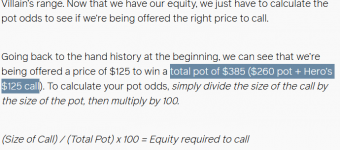
1787060507741
crushlivepoker.com/articles

Bart considers the total pot, this includes the call of the bet being faced.
He doesn't just go "125 into 260=", rather "125 into 260+125=".


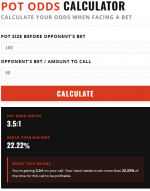
So with this in mind we can see now why you were wrong on betting 40 into 100 is "40 into 140" and offers 28% on the call, when in fact it's 40 into 140+40 which offers 22% to villain on his call, online calculators bear this out..

1787060870077
upswingpoker.com

22% not 28%(y)

@Mohamedkolea
The upshot of this is Semprini has a fundamental error in his replies and you need to be aware of this going forward.
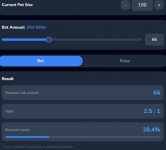
If you intend to follow his strategy and want to offer 28% to villain on his call you must bet around 66% pot not the 40% he has repeatedly stated.

Another nice online calculator bears this out..
1787061475108


I quite like the bet slider on this one and you might want to have a play and see how various bets affect the pots odds.
Classic benchmark is a pot sized bet offers 33% pot odds, try it out for yourself:)
 
Last edited by a moderator:
  • Love
Reactions: Mohamedkolea
Related Betting Guides: CA Betting - AU Betting - UK Betting - SportsBetting Poker - BetStars Starting Hands - Poker Hand Nicknames Rankings - Poker Hands
Top