Floating (Day 29 Course Discussion)

  • Thread starter Thread starter Debi
  • Start date Start date
carmenzu said:
I have already said it in another post, but I will say it again, I was delighted with the course, and I saved the playlist to enjoy listening to some chapters every day, repetition will help me to reinforce knowledge, read or listen to advice just one time is not enough.
Thanks, again.


That’s music to our ears and we’re so happy to hear it! Thanks, Carmenzu 🙂
 
  • Like
Reactions: Collin Moshman
Floating is a good strategy to play in the right spots especially good when on the button and you are the last to act.
But in some circumstances can be dangerous if he has the nuts, If 2 suited cards are on the flop and your opponent c-bets the flop I would put him on a draw to the flush or straight or even top pair with a good kicker in order for it to work you need the turn and river to match the single suited card from the flop so if it was Spade, Spade, Diamond on the flop and the turn and river came Diamonds on both it is very easy to assume he missed his Spade Draw and you can bet the Diamond flush If you are already holding the Ace of Diamonds bet out big enough and get the job done.
But be careful sometimes he may have hit his straight and see through this bluff.
 
  • Like
Reactions: Collin Moshman
For me, floating is a pretty good tool for winning my opponent's stack, especially if I'm a chip leader)
 
  • Like
Reactions: Collin Moshman
Pay now to win it later

This play is very useful when against aggressive players who always will c-bet the flop, or against very loose players who will bet wherever he hits something in the flop and you have really good odds of improving your hand.
 
  • Like
Reactions: Collin Moshman
quiz question

So, I got the quiz question wrong. I thought that folding Q8o was the proper play on the flop. I understand that in a tournament situation there are ICM considerations and we want to apply pressure. Let's say we are in a cash game instead. Would folding Q8o also be bad in that situation. Let's take it up a level, in a cash game, when facing a min-bet should we pretty much float with anything then?
 
  • Like
Reactions: Collin Moshman
SeniorTurtle said:
So, I got the quiz question wrong. I thought that folding Q8o was the proper play on the flop. I understand that in a tournament situation there are ICM considerations and we want to apply pressure. Let's say we are in a cash game instead. Would folding Q8o also be bad in that situation. Let's take it up a level, in a cash game, when facing a min-bet should we pretty much float with anything then?

Yes, I would also float this hand in a cash game. I wouldn't float a min-bet with 100% of hands playing cash, but definitely with a very wide range.
 
Quiz

Great spot to float but you could also raise the flop too
 
  • Like
Reactions: Collin Moshman
That's true. Floating generally has a lot of benefits over raising the flop, but raising gives you fold equity which makes it a worthwhile tradeoff in a number of spots.
 
  • Like
Reactions: Katie Dozier
I watched this lecture... and suddenly I saw myself from the outside... It looks funny. After all, that's how I play sometimes. And at the same time, it made me think about the nuances. There are weaknesses in tactics... And here I will keep silent...
 
I think floating is a serious topic for discussion. In most cases, we win small pots before the showdown and can lose big ones when we face a very strong opponent's hand. Sometimes our hand will improve, but the chances of that are small.
The key factors for floating are listed in the book. But you still need to be sure that it will work against a certain opponent. Because it is associated with the risk of losing a significant part of the stack. Some players, including me, use small bets of 30% of the pot with strong hands to get a call in most cases or provoke an opponent to raise. It can be very frustrating when you catch an opponent bluffing, but still lose because of 8 outs. Like in this hand.:icon_pale

2666
2667
 
Finished day 29...1 to go

I agree with Collins last statement: " it's a skill that requires you to really play poker" After watching this video I looked at my tournament hand history from last 3 tournaments and realized that there where some cases when I could have played some of the hands completely different. Imagine how many more hands I could have floated rather then raised or 3-bet if I looked at all the tournaments that I played. 🙁
 
Floating is very useful when you have position. You need to know who you can float and who you should not.

Position is king.
 
Nice lesson, I've been doind it inconsciously, just with the idea that I should balance my range, and that villains would less be atempted to c-bet with air, and controlling missed flops. The main mistake is to float on a big pot, you will oftely lose the hand, + it will cost you a lot. I've learned a lot during this session, so I'm really greatefull.
One lesson left 😀
 
Floating - I love this play. I've been doing it intuitively. Now I know it has a name. Cool!

My favorite quote from this lesson - "It's going to require us to play poker; to do fun things on later streets." Yes, that's what signed on for!
 
Finished Day 29

First of all I would like to thank Cardschat for this lesson, which allowed me to change the way of playing float spots.

I never thought of applying float in my game, but today I understood its importance.

The quiz answer:

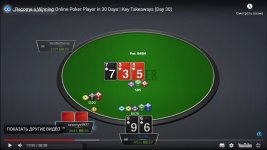
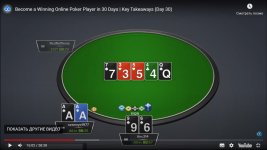
We can float :qs4::8h4: because villain bet small, he showed weakness and we can put the pressure on ICM to try to win the pot.
 
Floating, check it out, concept presenting at the last moment, nothing more opportune, it was very well presented, as well said it must be used with extreme caution, always in position, control low c-bets, so always focus on when and where to apply the tools that you hold.


29/30.
 
I have always been aware of my position in a hand and play to be in position.
Floating is yet another way to take advantage of the edge that you have by being in position.
I would add that it helps to know your opponent and is he capable of folding.
 
Hi. Day 29 finished.
Nice topic about floating.
Quiz:
We should raise, because his raise from villain show weak.

Ty.
 
Day 29 completed. Interesting evolution in poker strategy, this course truly has a lot of valuable information. Thanks for the dedication and knowledge you share.
 
If my opponent is not a player who folds easily (a calling station), what is the threshold for giving up on the float on the turn or river to avoid the mistake of continuing in a bad spot (Day 6)?
 
Day 29. This is arguably one of the most important lessons in the course! The topic of floating perfectly illustrates the line between simply playing your cards and truly understanding positional advantage and table dynamics. Colin did an excellent job breaking down the key factors for a successful float: the opponent's bet size, backdoor equity and ICM pressure. The final hand with Q8o was a masterclass. It was incredibly useful to see how to handle atypical situations—such as when an opponent makes strange min-bets on every street and how leveraging ICM pressure against a short stack allows you to take down the pot even without a made hand. Huge thanks to Colin and Katie for this course! The information is presented in a highly structured way, with no fluff. Looking forward to the final exam on Day 30!
 
Back
Top