


What is your strategy for assessing other players at your table?

  • Thread starter Thread starter nabmom
  • Start date Start date
nabmom

nabmom

Moderator
Moderator
Awards
17
US
Poker Chips
1,812
Casino Coins
81
I go beyond using their actual game play (how often they are in a hand, are they "insta-raisers" or limpers, etc.). I also get impressions based on their age, clothing, whether or not they have headphones or sunglasses, how they manipulate their chips and hold their cards.

When you are playing live poker (whether a tournament or a cash game), what are some of the things you notice about your opponents that you use to get a reliable read on them? And how does that impact your read and how you play against them?
 
  • Like
Reactions: ratbat615, Vallet, ammje and 3 others
Live play - its observing conversation, number of hands played, showdown cards, opening ranges, betting patterns, positional play - this is all factored in - i adjust to them as they tourney progresses - same as online play but with obviously less physical tells but you eventually get to a point where (if you have a strong read) you can fairly and accurately predict what a player will do before they have acted.
There are a few players i have reliable notes on - online so i set traps for them when they are at my table, it works 2/3 of the time and when it does not - i adjust my game accordingly.
 
I barely play any live poker but what i definitely do when i play is i try to analyze the whole character of a person and if their behavior is real or some fake edition just for the poker table. Age and how they dress definitely not to ignore. In what a mood/state of mind the person is could be another important clue.
 
  • Like
Reactions: fundiver199
Besides how players stack their chips, bet, raise or re-raise, I focus on their deviations from a "standard" behavior I would've noticed based on my observation as soon as we sit at the table. A silent player who suddenly starts talking for example and vice-versa. leaning forward while playing a particular hand. Sitting back or crossing arms after looking at a hand etc.
Those are only a very few things; I would need pages to mention everything that goes inside my head at the table.
Still, none of it is 100% reliable. People are different and, in some cases, like with professionals, the most obvious tell could be a deception.
 
The evaluation begins even before the person sits down at the table. In general, it basically involves observing patterns, evaluating and classifying each player based on how often they play and how they handle their bets.
 
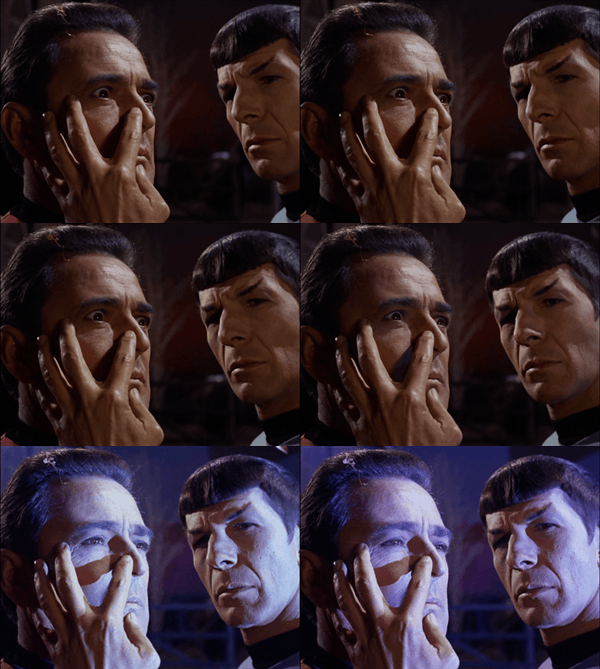
Oh this is a live play question 🤔 I usually shy away from those. At live tables Vulcan mind meld should do the trick 🤣
Online, especially on GG where most players are unknown I usually just look at their total winnings from that sorry excuse of a HUD. That gives me some estimate of does my opponent actually know what he/she is doing.


tumblr_nmeeh6DbZ71svmnqco2_400.gifv
 
nabmom said:
I go beyond using their actual game play (how often they are in a hand, are they "insta-raisers" or limpers, etc.). I also get impressions based on their age, clothing, whether or not they have headphones or sunglasses, how they manipulate their chips and hold their cards.

When you are playing live poker (whether a tournament or a cash game), what are some of the things you notice about your opponents that you use to get a reliable read on them? And how does that impact your read and how you play against them?

I only play online. I don't have the opportunity to play in live tournaments. But I have to say that aggressive opponents are the most convenient opponents for me. They are often willing to take risks, and I am willing to take risks when there is a reason to do so. And that's my big advantage, I always have a better chance of getting a good result 🙂
 
Tero said:
Oh this is a live play question 🤔 I usually shy away from those. At live tables Vulcan mind meld should do the trick 🤣
Online, especially on GG where most players are unknown I usually just look at their total winnings from that sorry excuse of a HUD. That gives me some estimate of does my opponent actually know what he/she is doing.


tumblr_nmeeh6DbZ71svmnqco2_400.gifv
I'm so impressed that other players let you get this close to them! 🤣
 
I don't see the other players online when I play , I guess this happens mostly live . Although now I remember a tournament on 888poker where players could use cameras and play live if my memory works good . Online the only info I get is by playing with the other players , watch their decisions . In the past I used to keep notes , nowadays bo . It's too time consuming .

If sb is not too right or too bad player , I cannot trick him and take advantage . Usually I am the fish at the tables)))))
 
Ruslan L said:
Eu só jogo online. Não tenho oportunidade de participar de torneios presenciais. Mas devo dizer que os oponentes agressivos são os mais convenientes para mim. Eles costumam estar dispostos a correr riscos, e eu também estou disposto a correr riscos quando há um motivo para isso. E essa é a minha grande vantagem: sempre tenho uma chance maior de obter um bom resultado.🙂
Watch out, the biggest chance in this game is to lose!
 
Often, players bet on a hand because they don't expect a good opportunity, and it takes a while before good cards appear. When you have a strong hand, you can take the advantage and win big!
 
Look at what they are drinking and go from there, red bull=LAG, coffee=OMC etc.🤣
 
  • Haha
Reactions: kunkgreen and nabmom
There is the stuff that is universal, strength of starting cards, position, how aggressive, do they steal blinds, can you steal their blinds.

I like to wear a ball cap and have it on in such a way as to watch their hands and them not being able to watch my eyes. For me watching the hands can tell a lot- how are they getting chips ready for a bet or raise, are they holding cards like they are waiting to discard or are they putting them in their place to play a hand. The opponents that have good luck trinkets will almost always put it on their cards if they are going to play a hand. You can also tell if they are relaxed or nervous watching the hands.

The more that I study hand movement gives me an insight that I can't get trying to watch facial activity.
 
  • Like
Reactions: sibkaz and nabmom
Gutshot Gus said:
There is the stuff that is universal, strength of starting cards, position, how aggressive, do they steal blinds, can you steal their blinds.

I like to wear a ball cap and have it on in such a way as to watch their hands and them not being able to watch my eyes. For me watching the hands can tell a lot- how are they getting chips ready for a bet or raise, are they holding cards like they are waiting to discard or are they putting them in their place to play a hand. The opponents that have good luck trinkets will almost always put it on their cards if they are going to play a hand. You can also tell if they are relaxed or nervous watching the hands.

The more that I study hand movement gives me an insight that I can't get trying to watch facial activity.
Interesting point about the hand motions. When I play live, and before it is my turn to act, I try to put my cards and card protector (mine is from CardsChat!) down exactly the same way whether I will play them or fold.

I was taught to never look at your own hand until it is your turn. And to use the time after the deal to watch what other people are doing and how they react when they look at their cards. But sometimes I can’t resist looking!
 
nabmom said:
Interesting point about the hand motions. When I play live, and before it is my turn to act, I try to put my cards and card protector (mine is from CardsChat!) down exactly the same way whether I will play them or fold.

I was taught to never look at your own hand until it is your turn. And to use the time after the deal to watch what other people are doing and how they react when they look at their cards. But sometimes I can’t resist looking!

I have never used a card protector. As long as you keep your cards on your side of the bet line they don't need protecting, and once you put them across the bet line they aren't yours. KISS and a card protector just adds another level for smart villains to exploit.
I usually wait my turn to look at my cards. If I know a villain is watching, I will do different things such as looking at cards longer when looking in turn and looking at cards before my turn. The general train of thought is that you look at good cards quick and take longer looking at bad cards.

Also if involved in a hand against a smart villain I watch him when cards are flopped, The best tell that a villain can get is watching you and by not letting him see you watch the cards flop you deprive him of that info. The cards are just laying there and you can look at them at your convenience when you think villain is not watching you.

Think of it as "Spy vs Spy" and enjoy the game within the game.
 
  • Love
Reactions: nabmom
When judging, thinking and assessing how good and what live players play like and their style it's about taking everything into account from the first second you get your first look at them. Age, gender, how they walk, dress, talk, what they drink/eat and even what they do for a living. It all paints a picture when it comes to poker players most times you can exactly judge a book by it's cover especially at lower stakes like 1/2 to 5/10.

One could write a book about this stuff and a number have been written about it I've read Mike Caro's book from back in the day and I'm likely not the only one here who has.

Cheers!!!
 
  • Like
Reactions: nabmom
Well it's definitely more difficult online, however you can watch their playing style throughout the game and get a decent sense of the player type. Won't always be correct until you have played with them for a while, but as you take notes, they will get more accurate.
 
For me, the most dangerous players are the most likeable; they disarm you, and often you don't get upset when you lose and feel embarrassed when you win.

I love talking to them, but I prefer to avoid confrontation.
 
I try to pay close attention to the other players at the table, but especially the ones two to my right and two to my left. I watch to see how many hands they play each round, if they limp, raise or call, if they play when out of position, if they defend their blinds. I always watch any showdowns so I can see the hands they play. Sometimes I take notes on my phone about them by seat number. When I first sit down, I look at chip stacks and the demographics of the other players (age, where they're from, clothing, demeanor, etc.). As a female in a male dominated game, I try to stay under the radar and just observe.
 
When online I refer to my notes and color coding if available . On the major sites I will sometimes look at sharkscope if deep in a MTT or SNG . At live ring games there are the many clues mentioned by previous posters . Chatting a bit with the players directly to your left and right can help get information about the motivation and experience of those opponents
 
I mostly focus on betting patterns, position, and how often they play hands. Physical stuff can give hints, but their decisions at the table tell the real story.
 
My approach starts with game flow and fundamentals before anything else. Early on, I focus on how often players enter pots, whether they’re limping or raising, and how they respond to pressure. Showdowns are especially valuable—seeing what hands people reach the river with tells me far more than a single physical tell.

That said, live poker does offer extra information. Things like bet sizing consistency, chip handling, and timing tend to be more reliable for me than clothing or accessories. I try to be careful not to stereotype too much based on appearance, but repeated behaviors—like hesitation before betting or sudden confidence—can become useful data points over time.

Most importantly, I reassess constantly. Players adjust, stacks change, and emotions come into play. I’ve found that staying flexible and updating reads is more important than locking someone into a category too early.
 
Bets, cards when opened, hands, time to think, reaction to provocations...)
 
Back
Top