You are using an out of date browser. It may not display this or other websites correctly.
You should upgrade or use an alternative browser.
You should upgrade or use an alternative browser.








You do not want to be calling with that hand type you can raise it but calling is not great. As to what to call 100% of suited is fine and connected off suit is fine. J8o is a much better call because you can flop a straight which is a huge advantage over the J7.78mariusz said:How wide do you guys defend your BB in MTTs against a button min raise. are you calling with stuff like J7o or just folding?
If you do not have strong post flop skills then you want to be more conservative with your range. You would start folding bad suited hands like 92s 93s 82s etc etc
🤔🤓


In my opinion, the GTO recommends too wide a defense against the big blind; if we are not skilled enough in the game after the flop, such a wide defense can put us in a difficult position. I prefer to play a little tighter until I get better — it's one of the most difficult positions.


Yeah, wide is right, just not J7o wide. The price is great — you're calling 1bb to win like 3.5bb, more with antes, so you only need around 20% equity — and that's why solvers defend basically every suited hand here.
But J7o is the bottom of the barrel. It flops top pair with a terrible kicker or second pair with no kicker, you're out of position the whole hand, and against a button range you're dominated constantly. You just don't realise your equity with hands like that.
Stack depth matters a lot too. Deep, you can defend wider with suited connectors and suited one-gappers because you can actually play postflop. Short — like 20bb or less — calling gets bad fast and it turns into more of a jam-or-fold spot.
And yeah, it depends on the opener. Against a tight button who barely opens, tighten up. Against a loose guy min-raising half his hands, defend even wider — just still fold the J7o.



hmmm interesting. What do you think about J7o against a BTN that opens really wide when antes are in play? I feel like the pot odds against a min raise are pretty good in this spot. On a slightly different note I'm curious how much your BB defending range changes depending on stack depth, say 20bb vs 50bb?eetenor said:You do not want to be calling with that hand type you can raise it but calling is not great. As to what to call 100% of suited is fine and connected off suit is fine. J8o is a much better call because you can flop a straight which is a huge advantage over the J7.
If you do not have strong post flop skills then you want to be more conservative with your range. You would start folding bad suited hands like 92s 93s 82s etc etc
🤔🤓


I tend to defend my BB relatively wide against a BTN min-raise, especially when antes are involved. The pot odds are attractive, and the button usually has a wide opening range.78mariusz said:How wide do you guys defend your BB in MTTs against a button min raise. are you calling with stuff like J7o or just folding?
With something like J7o, I'm comfortable calling against a loose opener under normal circumstances. However, stack depth, ICM pressure, and my opponent's postflop tendencies can change my decision. I don't want to defend blindly just because I'm getting a good price. Playing out of position with a marginal hand can easily become expensive.


Guys you know basic preflop chip ev ranges are free on several poker training sites? Why would anyone answer fold? It is an easy defend even against 2,5x let alone against a minraise. If you fold J7o against BTN minraise in chipev MTTs with antes then you should not be playing poker.
Attachments
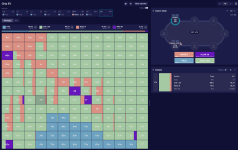
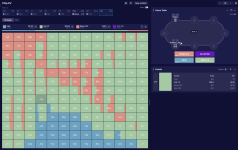


Defending the BB in MTTs really comes down to stack depth, opener position, and ante dynamics. Against late-position opens with medium-to-deep stacks, I defend wide with suited connectors, gappers, and high cards that play well post-flop, while tightening up my calling range against early-position opens and shoving clean hands when short.
True but just to be a bit contrarian here, the charts assume that both players play perfect GTO postflop. But the reality is, that the strategy for the out of position player is much more complicated and difficult to learn than the strategy for the in position player on many boards. The out of position player might be supposed to have a complex mix of leads, check-calls, check-folds and check-raises, whereas the in position player is supposed to more or less range-bet the flop if checked to. This is a simplification of course, but I think, you get the point.MTT Database Review said:Guys you know basic preflop chip ev ranges are free on several poker training sites? Why would anyone answer fold? It is an easy defend even against 2,5x let alone against a minraise.
So even with equal skills the out of position player will tend to make more mistakes postflop than the in position player, because they are in a more difficult situation. And for that reason it can be less expensive to take a small loss by not defending a marginal hand, especially if you are not super comfortable postflop. So if people think "nah I would rather get rid of that spot", its actually not totally crazy. While a GTO computer playing against another GTO computer will make money defending J7o, a human player might not.

Saul2025 said:Well, J7o isn't bad. Pot odds on BB are ridiculously good usually.
J7o is a linear hand with only 1 straight - 89T which would be a difficult board to get paid on. We want to have a draw equity hand like 75s which has 3 straights plus flush, something more polarizing. We don't want to play out of position and not as aggressor with a weak linear hand. Defending with a linear hand we would want something more like AJo that is ahead of more of a BT open raise. J7o is not ahead of much of that range at all.
3 factors:
Position, we don't have it.
Aggression, we are not the PFR.
Hand strength: J7o behind most of BT open range and low draw equity, meh.
The 4th factor would be stack and/or bubble. So this is generally a weak play. Nothing is in our favor. Even a 22 set mine attempt would be a better defend in my opinion, even though its equity is low, it is a polarized, monster-or-fold type of speculative hand.
MTT Database Review said:Guys you know basic preflop chip ev ranges are free on several poker training sites? Why would anyone answer fold?
This is a micro stakes game? You don't want to get too GTO here against an opponent who is likely just a fish or at the very least is not playing GTO ranges himself. Best to just tighten up a bit and J7o is one of the very first hands to drop when tightening in a spot like this.
