Hey guys,
I am new on Cards Chat, I am Peter from the Netherlands and I play poker for more then 15 years.
I’m interested in getting some outside opinions from experienced MTT players on my recent results and, more importantly, how you would evaluate the underlying play versus the results.
A little background first: I’m not new to tournament poker. Over the first years I played tens of thousands of online MTTs on PokerStars, Betfred, PartyPoker, Fulltilt Poker and so on, and was a winning player over that larger historical sample. I’ve shipped multiple large-field tournaments and had plenty of final tables and deep runs for serious figures. so I’m familiar with how extreme MTT variance can be.
Recently I’ve been playing low-stakes MTTs on GGPoker again, mainly regular MTTs, turbos, PKOs and Zodiac tournaments.
The sample below is only from the last few weeks, so obviously I’m not trying to establish a meaningful ROI from it. What I find interesting is how frequently I’m getting deep despite currently losing overall and running particularly badly in many of the major late-stage all-ins.
Some recent examples:
• 6th / 1,449 – low-stakes MTT
• 6th / 270 – low-stakes MTT
• 5th / 1,080 – low-stakes MTT
• Top 200 / ~16,000-player field – one of the biggest recent fields; the run ended around the stage where winning the major conversion pot would have put me around a 1.7M-chip stack with a 93% favor in the 1.2M pot with set 33 flop 3-4-9 guy shoved 200% pot with A9 suited (backdoor runner flush appeared).
• 23rd / 242 – ¥188 Zodiac Ultra Deepstack Turbo
• 28th / ~1,300 – $11 GOAT
• 27th / 822 – $22 Hyper/PKO
• 41st / 321 – $28 Tiger Turbo
• ~50th / ~3,200 – $3.20 Deep Turbo KO
• 82nd / 1,690 – $5.50 Fifty Stack
• ~60th / ~4,200 – $2.50 Mini Big Game
• 89th / 3,752 – $3.20 Bounty Hunters Deepstack Turbo
On one recent day alone I had 9 separate deep runs with top 5% finishes.
I don’t have every exact finish written down, so this isn’t meant to be a complete results graph. It’s just a selection of the recent runs that stood out in not a very big sample as I dont have time to grind daily like in my past.
I also review my game quite seriously.
I save a large amount of my tournament hands and interesting spots and review them afterwards. I’m not simply looking at whether I won or lost the hand. I try to reconstruct what the correct decision should have been based on all the information available at the time and tweak bet sizing and leaks and look for improvement in ranges.
The level I’m currently focusing on includes things like:
• effective stack sizes and changing strategy by stack depth
• positional ranges and range construction
• reshove, shove/fold and calling ranges
• blockers and fold equity
• player-specific exploits
• VPIP/tendencies and population tendencies
• table image and how previous hands affect later decisions
• ICM and risk premium
• stack distribution around the table
• bubble pressure
• bounty EV in PKOs
• future game value
• sizing and range interaction postflop
• identifying exactly which worse hands call and which better hands can realistically fold
I recently went through a structured review of 237 hands. I’m definitely not claiming that I play perfectly, because the entire reason I review is to find leaks, but I’m currently finding relatively few obvious fundamental mistakes.
Most of the things I’m identifying are smaller optimizations: sizing differences, marginal range adjustments, exploitative tweaks or spots where one line may generate slightly more EV than another.
That’s also why the recent results are interesting to me.
My impression is that I’m still accumulating chips quite well without simply relying on winning flips. A lot of the deep runs are being built through steals, reshoves, pressure, exploiting player tendencies, small-ball pots, postflop decisions and no-showdown accumulation.
The problem has mostly been the major conversion points later in tournaments.
I keep reaching spots where one all-in would suddenly move me from an average or short stack to a huge stack, sometimes into the top few stacks or around 1M+ chips. Those pots have been going wrong very frequently lately.
Sometimes they are normal 50/50 or 55/45 situations. Other times I’m getting the money in significantly ahead towarda 70% to 90% and still losing the pot.
I’ve also had situations where, for example, a huge late-stage pot ends in a split when I’m ahead preflop, followed shortly afterwards by another major conversion going wrong. The financial difference between winning and losing those late pots can obviously be enormous: instead of having a top stack with a realistic shot at hundreds or thousands of dollars, the run ends for a few dollars.
I’m not saying the site is rigged, and I’m not saying that because I was ahead I somehow deserved to win the hand. I understand that every individual all-in is just another probability.
I’m more interested in evaluating the overall pattern.
Historically, when I was playing badly or completely card dead, I simply didn’t make many deep runs. What I’m seeing now is different: even during a stretch where the all-in variance feels clearly below expectation, I’m still repeatedly getting into the final 1-5% of large fields with 500-15.000 players.
That makes me wonder how much value other experienced players place on deep-run frequency and decision quality when short-term profitability still looks bad.
So my questions are:
If a player has a historically winning sample over tens of thousands of MTTs and is now repeatedly reaching the final few percent of large fields, but is still losing during the recent sample because many of the biggest late-stage conversion pots are not holding, how would you evaluate that?
Would you consider the repeated deep runs meaningful evidence that the underlying game is strong?
Or would you basically ignore deep-run frequency and say that this recent sample is still far too small and noisy to conclude anything? This is just from few weeks but also before those I repeatedly get in the top end phase and am not afraid to go for top 3 finish, I dont want to end up 30th place blinding out, however, I do keep in mind risk premium and who to mess with or not to keep as many weopons in my arsenal and exploit without variance as main line. But sometimes you just go carddead for an hour or 2 without any spots and then losing the big conversions that could save it all.
And when reviewing your own game during a downswing, how much weight do you personally give to:
1. actual ROI/results
2. deep-run frequency
3. hand-review/decision quality
4. all-in EV and late-stage conversion variance
I’m especially interested in hearing from experienced MTT grinders who have gone through stretches where they kept reaching the business end of tournaments but repeatedly failed to convert those runs into final tables or wins.
I’m completely open to criticism as well. I’m not posting this to be told that I’m unlucky. I’m mainly trying to separate genuine evidence of an edge from results-oriented thinking and get some outside perspective.
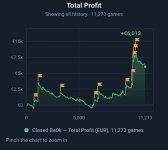
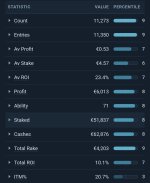
For additional context, my historical PokerStars sample is around 11,000 tracked tournaments on sharkscope, with approximately 23% average ROI and around $8,000 in profit. See pictures.
Thanks all!
Attachments
Last edited: