Matt Hunt (MTT Coach, Poker Fluency & Octopi Poker) - Ask Me Anything about solvers, studying, and learning poker

Octopi_Poker

Octopi_Poker

Rising Star
Bronze Level
US
Poker Chips
36
Casino Coins
0
Hi CardsChat,

I'm Matt Hunt, a professional tournament player and poker coach. Some of you might know me from the Poker Fluency YouTube channel. I've been playing for over 13 years, with 46 wsop cashes, 4 WSOP final tables, over $3 million in online earnings and $780,000 live.

These days most of my time goes into coaching. I've done more than 4,000 hours of one-on-one sessions with over 200 players, from dedicated hobbyists to serious grinders. Before poker I studied linguistics. That's a big part of how I coach: I focus less on handing people answers and more on helping them understand why, so they can keep improving on their own.

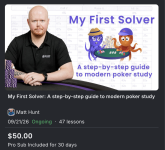
I've just released a new course with Octopi Poker called My First Solver. Most players have heard that solvers help, but the first time you open one it can be overwhelming. The course is built for tournament players who are new to solver study, or who tried it once and gave up. It has 47 lessons across seven modules. Over the course of it we study a hand from preflop all the way to the river, with quizzes and drills along the way. By the end you'll have a repeatable study routine you can follow on your own.

CardsChat have kindly agreed to let me run an Ask Me Anything thread. Ask me whatever you like, for example:

  • Solvers and study: how to read a sim, which spots are worth studying, and how to stop forgetting what you learned
  • Tournament strategy: preflop, postflop, ICM, specific hands you're stuck on
  • Coaching and learning: whether to get a coach, what to look for in one, and how to improve with a full-time job and limited time
  • Anything else: the mental game, running bad, my career, the WSOP

I'll be around starting today and will be answering questions for the next week or so.

Giveaway: Next Friday, I’ll pick my 5 favorite questions that I’ve been asked and each of those posters wins a free copy of My First Solver. A free copy also comes with 15 days of free Professional access on Octopi, so you can put what you learn straight into practice. Any question counts, beginner or advanced. The best ones are usually the questions people are a bit embarrassed to ask.

AMA!

Matt
 
  • Like
  • Love
Reactions: theStarfish, Debi, hoachec and 8 others
Hi Matt

What do you do to not get bored and impatient grinding long hours

-Live?

and

-Online?

Especially when the cards are not going your way.

Good luck with your projects 👍
 
  • Like
Reactions: Debi and Flyer35
Great to have you here, Matt!

My question would be: Are solvers a good idea for all levels of players (even low-level micro-stakes), or is there ever a time when they can be overkill? If yes, what or when would you estimate is a good level for a player to begin using them?
 
  • Like
  • Love
Reactions: G0930 and Flyer35
Sunz of Beaches said:
What do you do to not get bored and impatient grinding long hours

Bored? Playing poker?? Are you on the right forum? : P

My answer: open more tables.
 
  • Love
Reactions: Poker Orifice
Octopi_Poker said:
Hi CardsChat,

I'm Matt Hunt, a professional tournament player and poker coach. Some of you might know me from the Poker Fluency YouTube channel. I've been playing for over 13 years, with 46 WSOP cashes, 4 WSOP final tables, over $3 million in online earnings and $780,000 live.

These days most of my time goes into coaching. I've done more than 4,000 hours of one-on-one sessions with over 200 players, from dedicated hobbyists to serious grinders. Before poker I studied linguistics. That's a big part of how I coach: I focus less on handing people answers and more on helping them understand why, so they can keep improving on their own.

I've just released a new course with Octopi Poker called My First Solver. Most players have heard that solvers help, but the first time you open one it can be overwhelming. The course is built for tournament players who are new to solver study, or who tried it once and gave up. It has 47 lessons across seven modules. Over the course of it we study a hand from preflop all the way to the river, with quizzes and drills along the way. By the end you'll have a repeatable study routine you can follow on your own.

CardsChat have kindly agreed to let me run an Ask Me Anything thread. Ask me whatever you like, for example:

  • Solvers and study: how to read a sim, which spots are worth studying, and how to stop forgetting what you learned
  • Tournament strategy: preflop, postflop, ICM, specific hands you're stuck on
  • Coaching and learning: whether to get a coach, what to look for in one, and how to improve with a full-time job and limited time
  • Anything else: the mental game, running bad, my career, the WSOP

I'll be around starting today and will be answering questions for the next week or so.

Giveaway: Next Friday, I’ll pick my 5 favorite questions that I’ve been asked and each of those posters wins a free copy of My First Solver. A free copy also comes with 15 days of free Professional access on Octopi, so you can put what you learn straight into practice. Any question counts, beginner or advanced. The best ones are usually the questions people are a bit embarrassed to ask.

AMA!

Matt

Matt, I've tried to use solvers a few times and always get bogged down with information and give up. If you were to recommend a way for someone to work with a solver on a daily basis and not get confused and not try to learn everything at once, what would that look like? How much time do you think someone should dedicate to it?
 
Semprini said:
Bored? Playing poker?? Are you on the right forum? : P

My answer: open more tables.
Well i asked OP and not anyone else about it 😅

Playing long live hours can be boring. Online im aware i can just open more tables but sometimes i might play something very important where i dont want to have too much other tables open. So its stil possible to get bored, especially when carddead.
 
Nameless14 said:
Matt, I've tried to use solvers a few times and always get bogged down with information and give up. If you were to recommend a way for someone to work with a solver on a daily basis and not get confused and not try to learn everything at once, what would that look like? How much time do you think someone should dedicate to it?
Not to get in the way of Matt's answer when he returns, but I too had that problem. I noticed a huge increase in my confidence with solvers after taking the "My First Solver" course at Octopi Poker. It's only $50 USD for the course (including 30 days of Pro access) or $90 USD for 90 days of Pro access (which includes the course).

Screenshot 2026 10 03 at 122659PM

Matt is offering the course here as a prize to 3 people.
 
Last edited:
  • Like
  • Love
Reactions: Nameless14 and Octopi_Poker
What is the #1 adjustment or consideration micro/low buy in MTT players should make during their GTO study and particularly, application?
 
  • Like
Reactions: Flyer35
Sunz of Beaches said:
Hi Matt

What do you do to not get bored and impatient grinding long hours

-Live?

and

-Online?

Especially when the cards are not going your way.

Good luck with your projects 👍
This is one I struggle with, since I have pretty severe ADHD and long hours are difficult for me.

That said, it's really only difficult on day one, since I'm usually pretty locked in on day two+ of a tournament.

If variance not going your way starts to affect how you play, that's generally a bigger issue than just lack of concentration. I think whether it's live or online poker, it's important to have some kind of process before and after you play that can help you transition into and out of your session, and to really understand what your motivations are for playing.

A lot of tournament players fall into complacency, and eventually start just showing up with the hope of going through the motions and running good, which is never a recipe for success. If you focus on identifying and taking every possible edge you can, then not only will you likely stay more attentive at the table, but you'll probably be involved in more hands as well - a lot of the time the reason players get bored is because they're simply playing too tight.

If you're a tournament player and your VPIP is less than 30%, you're probably missing a bunch of spots.
 
  • Like
  • Love
Reactions: Debi, Sunz of Beaches, fundiver199 and 1 other person
Tammy said:
Great to have you here, Matt!

My question would be: Are solvers a good idea for all levels of players (even low-level micro-stakes), or is there ever a time when they can be overkill? If yes, what or when would you estimate is a good level for a player to begin using them?
I think it all depends on how you use them, tbh. If you're just going to click through random things and look at spots then you're not going to get much out of it no matter what level you're at.

Players can begin using solvers at almost any level, provided they have a rudimentary understanding of the basic ideas and principles of the game - but in the early stages, it's much more appropriate to focus on using them preflop to just nail your basic opening ranges and other preflop strategies, rather than diving into the complexities of multi-street postflop play.

As time goes by, poker learning is likely to become more and more dominated by technology, and there's no putting the genie back in the bottle at this point. I don't really see any future point in time where a player can achieve their full potential as a poker player without using solvers at all. But if you're just looking to be a casual poker player and not lose a ton of money, they're probably less important overall. Hope that helps!
 
  • Like
Reactions: nilsharker and fundiver199
Semprini said:
Bored? Playing poker?? Are you on the right forum? : P

My answer: open more tables.
I actually strongly advise against this.

I think the vast majority of online players play too many tables, and would benefit from playing fewer tables and slightly higher buyins. There are a ton of players punting off money by just firing off a bunch of tournaments they don't care about, just for the sake of occupying more brain space.
 
  • Like
  • Love
Reactions: fundiver199 and Flyer35
monkeytilter said:
What is the #1 adjustment or consideration micro/low buy in MTT players should make during their GTO study and particularly, application?
I think it's to recognize that some of your opponents actually are playing somewhat close to GTO in certain spots, simply because the GTO strategy is not particularly difficult to achieve.

For example, if your opponent has five big blinds and shoves all-in from early position, there's a decent chance that their shoving range is relatively close to what the GTO shoving range is for that particular spot - or at least, you're not going to be able to know the difference between a player who is 5% too wide, and a player who is 5% too tight. So the only recourse you have is to understand what the default calling range is against a 5bb UTG shove, and try to implement that strategy.

Same goes for a flop spot where your opponent just range-bets 25% of the pot - there are tons of those spots where it's completely correct to do that. So at low stakes, the most important thing is to identify the spots where the GTO strategy is reasonably easy to achieve (or even accidentally achieve, for a player who has no idea about GTO), and focus on understanding the GTO response against that strategy.

The idea that a human player can play GTO across the entire game tree is of course inaccurate, but a human player absolutely can stumble into a GTO strategy in a specific situation, and if there's no exploit to be found, then we have to be able to have some idea of what the best strategy against that might look like.
 
  • Like
Reactions: fundiver199 and monkeytilter
Octopi_Poker said:
over $3 million in online earnings
You've clearly had a lot of success playing online. Could you give us perhaps three insights into what went into becoming a successful online poker player? I'd be particularly interested to hear if GTO solvers played a role.
 
Octopi_Poker said:
As time goes by, poker learning is likely to become more and more dominated by technology, and there's no putting the genie back in the bottle at this point. I don't really see any future point in time where a player can achieve their full potential as a poker player without using solvers at all. But if you're just looking to be a casual poker player and not lose a ton of money, they're probably less important overall.
Yes, I'm making that transition myself. It probably comes down to where you want to take your game. I've been relying on instinct for a long time, but I never really had any specific ambitions before either. I've always been a casual, low ambition player. I'm kind of thinking now I'd like to take it further, hence my interest in the science of poker, which right now means solvers.
 
Octopi_Poker said:
I actually strongly advise against this.

I think the vast majority of online players play too many tables, and would benefit from playing fewer tables and slightly higher buyins. There are a ton of players punting off money by just firing off a bunch of tournaments they don't care about, just for the sake of occupying more brain space.

The vast majority of players that we speak to on these forums only play one table and are afraid to play 2 tables. If we have a 2nd table, it;s twice the action. If we are folding 70% of our hands pre, we will STILL have downtime here and there. I'm actually most comfortable with 3 tables myself.
 
  • Like
Reactions: Flyer35
Hi Matt

Great to have you here. In your opinion what is the biggest adjustments someone need to make, if they are already a winning player in micro and low stakes tournaments (<$20) but want to attempt to move up to mid- and perhaps eventually high stakes?
 
  • Like
Reactions: hardongear and Sunz of Beaches
Flyer35 said:
You've clearly had a lot of success playing online. Could you give us perhaps three insights into what went into becoming a successful online poker player? I'd be particularly interested to hear if GTO solvers played a role.
To be honest, the majority of my online career (at least the portion where I played the vast majority of my ~8 million or so online hands) took place mostly in the era before solvers existed.

I moved to the US in 2017 (two years after the release of PIOSolver, and multiple years before solver libraries became more widely available), and although I've played a good amount online since then, it's nothing compared to the grinding I used to do before that.

Having said that, I think solvers have played a big role in my development ever since they've been around. Even within the US online environment, a lot of players are actively studying with solver tools, and I don't think it would be realistic to expect to be able to keep up with players at a high level without using the same tools as they are.
 
  • Like
Reactions: Flyer35
fundiver199 said:
Hi Matt

Great to have you here. In your opinion what is the biggest adjustments someone need to make, if they are already a winning player in micro and low stakes tournaments (<$20) but want to attempt to move up to mid- and perhaps eventually high stakes?
Mostly it's getting comfortable with the necessity of taking highly aggressive lines in a variety of spots and ensuring your range always has enough bluffs in it.

You can have a certain amount of success at low stakes just playing tight and focusing mostly on value (primarily by virtue of how many loose-passive opponents there are), but if you want to achieve success at higher levels you simply can't be a tight player.

The best way to approach it is to think about becoming the type of player that you, and other low-stakes winners, least like to play against. If you're going to succeed at higher stakes then you'll have to be a significant winner against players who are themselves winners at low stakes, and so you need to start thinking, "if I was going to play against myself, how would I exploit me?" - that's usually the best route.
 
  • Like
Reactions: Flyer35 and Sunz of Beaches
Back
Top