Matt Hunt (MTT Coach, Poker Fluency & Octopi Poker) - Ask Me Anything about solvers, studying, and learning poker

  • Thread starter Thread starter Octopi_Poker
  • Start date Start date
monkeytilter said:
Following on from that am I the only one that struggles to immediately "read" and "bucket" equity (distribution) charts?
View attachment 418163

Does it leap out who has the nut and range advantage, how much of each range is "middling"/"trash"?
Does that come with practice?

Has anyone developed (in books, articles or software) 'equity density' diagrams like this?..

View attachment 418164

(Player 1:Button as PFR, Player2:BB calling - Flop comes AK4r)
X axis is equity (hand vs range) 0..100% left to right.
Y axis is the "density" or frequency that equity occurs in each players range.

To me the 'buckets' leap out now:
BTN has the nut advantage with the big blue peak on the right;
BTN has range advantage as their blue curve is massed to the right of BB's curve;
BTN does have some "middling" hands also that might need strategy consideration;
BB has a trash overload with the orange peak on the left.
I do like the second kind of graph, so that's a nice way of displaying it.

However, the key to reading the first graph is just to understand that it's all about the gap between the lines, and where the gap is largest. This particular graph represents a spot where the BTN has a solid range advantage throughout most of the range - they don't have a big advantage at the very top, but they do throughout the majority of the middle portions.

I would expect the graph featured here to lead to a range-bet spot for the BTN for a small size, given that their advantage is significant, but not especially isolated to the upper portion of the ranges.
 
  • Like
Reactions: Debi and monkeytilter
Hi Matt!

So my question is this:
After breaking through the bubble on MTT's I find myself either blinding out to super aggro players or playing too tight and flunk out on the next table or two. How do I get past this "block" and start making FT's or at least within top 15? I've heard playing more aggressively early on before the bubble and up to 5mins before but a lot of the time that only loses me money and I will be buying in 4 or 5 times over? What am i missing?

Thank you!
 
How would you convince people that open limping and worse yet open limping with players sitting out(aka sitter limping) is far from optimal play?

Its a real epidemic in the CardsChat games.
 
  • Haha
Reactions: SpanRmonka
TeUnit said:
How would you convince people that open limping and worse yet open limping with players sitting out(aka sitter limping) is far from optimal play?

Its a real epidemic in the CardsChat games.
This is an unfair question, not even a solver can sort this problem out! 🤣
 
  • Like
  • Haha
Reactions: najisami and Tammy
MagikMunkey said:
Hi Matt!

So my question is this:
After breaking through the bubble on MTT's I find myself either blinding out to super aggro players or playing too tight and flunk out on the next table or two. How do I get past this "block" and start making FT's or at least within top 15? I've heard playing more aggressively early on before the bubble and up to 5mins before but a lot of the time that only loses me money and I will be buying in 4 or 5 times over? What am i missing?

Thank you!
This is a super common issue in MTTs (I actually have a YouTube video coming out about it soon). There are a lot of reasons for it, but it mostly tends to come down to two things:

1. Simple risk-aversion, folding spots that are profitable just because they require some level of risk
2. Just making a bunch of mistakes at below 30bb, which is often tied to the above

There's a lot more to it, but the most important thing is just to stop caring so much about the bubble. The bubble is not that big of a deal. Yes, it sucks to bubble a tournament but you will bubble a bunch of tournaments in your career. Your goal is to win the tournament, and if you're not playing a satellite, you absolutely can and should still be taking plenty of aggressive lines in the period leading up to the bubble.

On top of that, when it comes to the early stages, if you find that playing more aggressively leads to you having to buy in multiple times, it just means you're not playing aggressively in the right spots. Aggressive poker is good poker, and if you take the right spots early on, it will lead to building bigger stacks in the early stages, and not having to fire so many entries.

But having said that, firing multiple entries is not a bad thing. If you make the right plays and you end up busting a few times as a result, it's just not a big deal, it's how tournaments work.

Hope that helps!
 
  • Like
Reactions: MagikMunkey
TeUnit said:
How would you convince people that open limping and worse yet open limping with players sitting out(aka sitter limping) is far from optimal play?

Its a real epidemic in the CardsChat games.
It's certainly a mistake in most cases, but I'm a little confused as to why you would want to convince them that it's bad. Are you coaching them? If so, I would recommend illustrating with some examples why the EV of limping is lower than raising.

If you're not coaching them or they're your opponents, then just let them keep doing it and punish them for it. If limping is a 'real epidemic', it just means that players are making a lot of mistakes you can exploit.
 
mhunt_octopi said:
It's certainly a mistake in most cases, but I'm a little confused as to why you would want to convince them that it's bad. Are you coaching them? If so, I would recommend illustrating with some examples why the EV of limping is lower than raising.

If you're not coaching them or they're your opponents, then just let them keep doing it and punish them for it. If limping is a 'real epidemic', it just means that players are making a lot of mistakes you can exploit.
These are forum games, its not big money, and I want them to improve. Its also nice to play poker, rather than watch a limpathon.

Its like Doug Polk says "Friends dont let friends open limp".
 
Last edited:
  • Haha
Reactions: Poker Orifice
TeUnit said:
How would you convince people that open limping and worse yet open limping with players sitting out(aka sitter limping) is far from optimal play?

Its a real epidemic in the CardsChat games.
You can solve this urself by simply no more register to freerolls and instead buying into games above 5 Bucks. Actually even in 1-2 $ tournaments you will see significant less limpers and "sitters".

Obv noone is able to collectively convince a group of people that regularly changes (with people coming and going), to no more execute a certain beginner move. In games where half the field is on beginner level and a big part of the field is playing for fun and does not care at all about theory.
 
Last edited by a moderator:
  • Like
Reactions: fundiver199
TeUnit said:
How would you convince people that open limping and worse yet open limping with players sitting out(aka sitter limping) is far from optimal play?
Why would you want to convince people of that? When I was playing cash games, I ran different filters in my PT4 to see, where I was winning or losing money. And the situation "rasing over a limp" was insanely profitable. I think, it was close to 100BB/100. So if you care about winning money in poker, you should be extremely happy to see people limp in situations, where they should either have folded or raised. This is a sign, you are playing in good soft games.
 
  • Like
Reactions: SpanRmonka and G0930
Octopi_Poker said:
You can have a certain amount of success at low stakes just playing tight and focusing mostly on value (primarily by virtue of how many loose-passive opponents there are), but if you want to achieve success at higher levels you simply can't be a tight player.
Tight play can get you far though .
I finished 177th of over 7k players in the GGMasters and won 576$ , which I was very happy about since I only used a ticket - so 100% profit.

But I suppose you're right in the long run this won't happen often with tight only play.
My average VPIP on GG is 24%
What percentage would you consider a good ratio?
 
Oh it's actually 22%
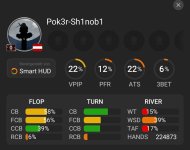
Would love your opinion on these stats.
Where should I improve?
Screenshot 20261011 133124 com nsus poker liveggpcom MainActivity
 
Maybe Matt has further input but ramp up your preflop aggression. PFR, ATS and 3-bet are all on the low side of, what is normal for winning players.
 
fundiver199 said:
Why would you want to convince people of that? When I was playing cash games, I ran different filters in my PT4 to see, where I was winning or losing money. And the situation "rasing over a limp" was insanely profitable. I think, it was close to 100BB/100. So if you care about winning money in poker, you should be extremely happy to see people limp in situations, where they should either have folded or raised. This is a sign, you are playing in good soft games.
Guess I am weird, I kinda think that this a poker forum and most people come here to improve their game, especially in the learning poker section. The biggest leak that I see in the games is the open limping and the sitter limping. It could save a lot of players here a lot of money if they fixed this simple leak.

Its seems a bit strange for people who are constantly openly limping to be talking about GTO. I have always thought that you should exploit when you can and GTO when you cant, but the open limpers are only exploiting themselves.

Your forum posts have helped a lot of players here improve, not sure why this subject would be any different.
 
  • Like
Reactions: Poker Orifice and Hnum2532
TeUnit said:
These are forum games, its not big money, and I want them to improve. Its also nice to play poker, rather than watch a limpathon.

Its like Doug Polk says "Friends dont let friends open limp".
I would politely question why you feel like limping doesn't count as "playing poker". 😉

Most players have an aversion to playing multiway pots, so be careful you're not falling into this trap as well. Obviously they're making mistakes, but you don't control what they do, and it might be more productive to put your energy into figuring out how to exploit their limping strategies to the greatest possible degree.
 
  • Like
Reactions: Tammy and fundiver199
G0930 said:
Tight play can get you far though .
I finished 177th of over 7k players in the GGMasters and won 576$ , which I was very happy about since I only used a ticket - so 100% profit.

But I suppose you're right in the long run this won't happen often with tight only play.
My average VPIP on GG is 24%
What percentage would you consider a good ratio?
Any kind of play can get you far - you could shove all-in every hand and still get lucky enough to make a semi-deep run in a tournament. To be blunt about it, a single tournament doesn't actually tell you anything about how well you played. Anyone who plays a lot of poker over a lifetime will have sessions or tournaments where they play well below their best but make a deep run, and tournaments where they play their absolute peak but bust early.

A VPIP of 24% is a reasonable starting point, but over a large sample you probably want to be hitting 30% if you want to avoid missing spots.
 
  • Like
Reactions: SpanRmonka, fundiver199 and G0930
G0930 said:
Oh it's actually 22%
Would love your opinion on these stats.
Where should I improve?
View attachment 418566
I don't know what every one of these stats means, but you're very much on the tight-passive side overall.

You're not c-betting flops enough, you're folding to c-bets far too much, and you're not raising or check-raising enough either. You're also not 3-betting preflop enough or opening wide enough in late position (otherwise known as 'stealing', a term which I don't like too much for a few reasons).

The river stats are the ones I can't easily interpret here (no idea what 'WT' and 'TAF' are) but I would suspect you probably have the same leaks as most other players, which is over-folding and under-bluffing.

This set of stats is a very archetypal set of stats for the average recreational tournament player, to be honest. A huge chunk of the player pool plays exactly like this, so a good way forward is to just start thinking about how you would exploit yourself if you played against you.
 
  • Like
Reactions: SpanRmonka, fundiver199 and G0930
mhunt_octopi said:
I don't know what every one of these stats means, but you're very much on the tight-passive side overall.

You're not c-betting flops enough, you're folding to c-bets far too much, and you're not raising or check-raising enough either. You're also not 3-betting preflop enough or opening wide enough in late position (otherwise known as 'stealing', a term which I don't like too much for a few reasons).

The river stats are the ones I can't easily interpret here (no idea what 'WT' and 'TAF' are) but I would suspect you probably have the same leaks as most other players, which is over-folding and under-bluffing.

This set of stats is a very archetypal set of stats for the average recreational tournament player, to be honest. A huge chunk of the player pool plays exactly like this, so a good way forward is to just start thinking about how you would exploit yourself if you played against you.
Appreciate the the feedback , thank you !
 
  • Like
Reactions: fundiver199
mhunt_octopi said:
The river stats are the ones I can't easily interpret here (no idea what 'WT' and 'TAF' are) but I would suspect you probably have the same leaks as most other players, which is over-folding and under-bluffing.
TAF is total aggression frequency and WT is went to showdown. But here (WT) I interpret the low percentage as rather good than bad.
WSD is Won at Showdown
 
mhunt_octopi said:
I would politely question why you feel like limping doesn't count as "playing poker". 😉

Most players have an aversion to playing multiway pots, so be careful you're not falling into this trap as well. Obviously they're making mistakes, but you don't control what they do, and it might be more productive to put your energy into figuring out how to exploit their limping strategies to the greatest possible degree.
I think your multiway point is very good and I try heed Dusty Schmidt's teachings on how to deal with limpers.

Open limping and open limping with players sitting out does not really seem like poker to me at "normal" stack depths, it seem more like bingo- limping a bad hand, out of position, with no initiative. Its really like fighting against math every step of the way.

I am not talking about Phil Helmuth open limping 18.5 bb with AQ because he is playing against a bunch of game theory optimal players.

Or someone limping the button with 6bbs trying to widen their range and I am not talking about the short stack plays like " a limp and go" and I am not talking about limping the sb in a hu hyper or about limping AA with 10bbs against villans that isolate most limps.

I was really just speaking about open limping a bad hand against a bunch of exploitable players in a mtt at "normal" stack depth, I should have been more clear.🙂
 
Last edited:
  • Like
Reactions: Poker Orifice
mhunt_octopi said:
I would politely question why you feel like limping doesn't count as "playing poker". 😉

Most players have an aversion to playing multiway pots, so be careful you're not falling into this trap as well. Obviously they're making mistakes, but you don't control what they do, and it might be more productive to put your energy into figuring out how to exploit their limping strategies to the greatest possible degree.

In fairness to Te, I think that we all know what he means. The worst and most common habit that fish have is limping (and limp-calling) pre wide from any seat. Obviously that is what he means (not a strategic set mine with 44 from the SB after 2 other limpers, say), and I'm guessing that even a player as high level as yourself would admit that is is PROBABLY the easiest way to spot fish at the table.

As for why he would urge them to stop it and improve, I won't speak for him, but I'm guessing that he doesn't mean when playing against them, but rather when discussing on a forum like this, as do I. Whenever the question comes up on this forum, "What is the most common mistake that new players make in Hold'em?" I always answer, "Chronic limping. Limping and limp-calling too wide/high frequency with little to no regard for action nor position." I answer this to genuinely help people improve their game. Now, when they are at the table against me, please do limp away so I can exploit their sorry butts! : P No mercy! Actually that's not exactly true, I have been known to advise people in moments of friendly table banter (not too often).
 
  • Like
Reactions: TeUnit
My question for Matt:

My heads-up game could use some help. Post-flop spots where we have a weak made, say bottom pair flop or 3rd pair turn (or some equivalent whiffed pocket pair 55, 66 or something), little to no draw equity, and Villain is aggro. Or same spot(s) with decent draw equity. What do you recommend?
 
Semprini said:
In fairness to Te, I think that we all know what he means. The worst and most common habit that fish have is limping (and limp-calling) pre wide from any seat. Obviously that is what he means (not a strategic set mine with 44 from the SB after 2 other limpers, say), and I'm guessing that even a player as high level as yourself would admit that is is PROBABLY the easiest way to spot fish at the table.

As for why he would urge them to stop it and improve, I won't speak for him, but I'm guessing that he doesn't mean when playing against them, but rather when discussing on a forum like this, as do I. Whenever the question comes up on this forum, "What is the most common mistake that new players make in Hold'em?" I always answer, "Chronic limping. Limping and limp-calling too wide/high frequency with little to no regard for action nor position." I answer this to genuinely help people improve their game. Now, when they are at the table against me, please do limp away so I can exploit their sorry butts! : P No mercy! Actually that's not exactly true, I have been known to advise people in moments of friendly table banter (not too often).
Generally yeah, I would say it's the easiest way to spot fish. I did get what he meant, but I just wanted to highlight the fact that time spent thinking about why other players insist on limping is time that could also be spent on your own game. Our opponents are gonna do whatever they want, that's the beauty of the game. 🙂
 
  • Like
Reactions: Tammy and fundiver199
Semprini said:
My question for Matt:

My heads-up game could use some help. Post-flop spots where we have a weak made, say bottom pair flop or 3rd pair turn (or some equivalent whiffed pocket pair 55, 66 or something), little to no draw equity, and Villain is aggro. Or same spot(s) with decent draw equity. What do you recommend?
This is too generalized, tbh. There's no way to apply a universal approach in a format as complex as heads-up, but what I can say is that any time I hear someone expressing ideas like "I tend to have problems with XYZ type of hand", it's rarely about the actual hands themselves.

Facing tough spots against aggressive players with the middle or bottom of your range isn't something you can inherently avoid, especially heads-up, but the reality is that there are some spots where those hands will want to fold, some spots where they want to call, and some spots where they might want to bluff-raise.

What will make the difference in your game overall is getting more familiar with the broader shape of the strategies for certain board textures, how our responses against aggression differ from one spot to another, and how the incentives of certain hands alter based on how much showdown value they have.

This might require revisiting your flop strategies, or adjusting how you analyze and study turn scenarios, but one way or another, there's no easy fix for playing against aggression, which is why it's basically impossible to play good poker without playing aggressively.
 
  • Like
Reactions: Tammy and fundiver199
TeUnit said:
I think your multiway point is very good and I try heed Dusty Schmidt's teachings on how to deal with limpers.

Open limping and open limping with players sitting out does not really seem like poker to me at "normal" stack depths, it seem more like bingo- limping a bad hand, out of position, with no initiative. Its really like fighting against math every step of the way.

I am not talking about Phil Helmuth open limping 18.5 bb with AQ because he is playing against a bunch of game theory optimal players.

Or someone limping the button with 6bbs trying to widen their range and I am not talking about the short stack plays like " a limp and go" and I am not talking about limping the sb in a hu hyper or about limping AA with 10bbs against villans that isolate most limps.

I was really just speaking about open limping a bad hand against a bunch of exploitable players in a mtt at "normal" stack depth, I should have been more clear.🙂
I would suggest that the reason it doesn't feel like poker to you probably has a lot to down with how you build your strategies against it.

If your opponents are trying to play bingo, your job is to remind them that we're not playing that game!

And FYI, while I respect his contributions to poker theory and coaching, relying on Dusty Schmidt's teachings in the age of solvers is a bit like choosing to communicate by carrier pigeon instead of text messages. 😛
 
  • Like
  • Haha
Reactions: najisami, Tammy and fundiver199
Hey Matt, welcome to CardsChat! Great to have you here and answering questions from our amazing loyalers!!!

My questions to you:

1) Do you advocate for playing on multiple online sites and dividing your bankroll among multiple sites, potentially limiting your ability to play higher stakes, or keeping your funds mostly on one main site where you may have a psychological advantage if you played up in stakes?

2) What is your personal opinion on moving up in stakes - do you like taking small shots or waiting until you are able to sustain yourself at a higher buy-in?

3) Do you have a personal breakdown between the number of tournaments you play that are straight cash versus satellites, where you need to cash twice to effectively make a profit?

Looking forward to your answers Matt!

Cheers
Chris
 
  • Like
Reactions: fundiver199
Back
Top