Lodestone
Rock Star
Platinum Level
- Joined
- Apr 16, 2026
- Total posts
- 214

- Poker Chips
- 97
- Casino Coins
- 5
- #1
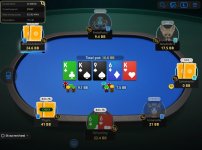
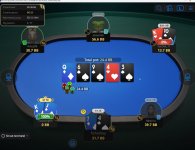
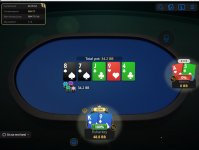
Got into a very ugly situation that lead to me going from 3rd chip leader to busting right before the bubble. Not sure how much was on me and how much was just bad luck.
I gave DeepSeek this prompt:
When you're playing a poker tournament, and you're the third chip leader but you have the 1st and 2nd to your left and right with 30 players remaining, what are the correct adjustments to make to your range and play?
Also, the last subpoint in section 2 seems way off and I'm curious what you all think "SB: Tighten way up if #2 (BTN) folds and you face #1 in the BB. Open only 88+, AJo+, ATs+, KQ." Having a tighter range blind vs blind seems insane to me and comes off as a hallucination. What do you think of the AI output and what would you add/change?
I gave DeepSeek this prompt:
When you're playing a poker tournament, and you're the third chip leader but you have the 1st and 2nd to your left and right with 30 players remaining, what are the correct adjustments to make to your range and play?
While the answer was in depth, it was pretty unsatisfying, the only thing that I think I didn't do properly in the game was #4. I was too nitty in the BB because they had me covered. I honestly think the thing that hurt me the most was the mental aspect and the very last point on 'Exploiting fear' might have been helpful. Going from being the bully at the table, chipping up using ICM as a weapon and stealing relentlessly to being stuck in jail forced to nit it up was torture and felt so unfair. I know table movements are random but it felt personal lolHaving both the #1 and #2 chip stacks on your immediate left and right with 30 left is one of the toughest table dynamics in a tournament. You’re effectively pinned between the two players who can inflict the most damage, while the #1 stack always has position on you. However, you also hold a big stack yourself, so you can’t just nit up completely. The right adjustments blend tight discipline, selective trapping, and exploiting the one spot where you have position.
1. Understand the core problem
Because the #1 leader never folds before you act (he’s directly behind), you are vulnerable in every single hand unless he voluntarily folds. Adjust accordingly.
- #1 stack to your left → always acts after you preflop, always has position postflop. He can 3-bet you light, call in position, and make your life miserable on every street.
- #2 stack to your right → you have position on him. That’s your main advantage, but the #1 stack behind you acts as a permanent squeeze threat if you merely call.
2. Tighten your opening ranges significantly
Your standard opening ranges must shrink from all positions because the #1 stack can 3-bet with impunity. Focus on hands that can either 4-bet get it in or flop well enough to withstand pressure.
Suggested RFI ranges (30–40 BB effective):
If the #1 leader is known to 3-bet very wide (e.g., >15–18%), narrow even further and consider adding limp-re-raises with premiums (see below).
- UTG/UTG+1: JJ+, AK, AQs (sometimes TT if the table is passive, but not when #1 is active).
- HJ: TT+, AQ+, AJs+, KQs.
- CO: 99+, AJ+, ATs+, KJs+, QJs.
- BTN: 77+, AT+, A9s+, KQ, KTs+, QTs+, JTs.
- SB: Tighten way up if #2 (BTN) folds and you face #1 in the BB. Open only 88+, AJo+, ATs+, KQ.
3. Against an open from the #2 stack (on your right): 3-bet or fold
Flatting the #2 stack’s open is dangerous because it invites the #1 stack to squeeze. Reverse this by almost never having a flatting range – you either 3-bet to isolate or you fold.
3-bet for value: JJ+, AK (and AQs if he opens wide).
Bluff 3-bets: A5s–A2s, KQo, KJs (fold to a 4-bet).
Flatting range: Only as a trap. Mix in flat calls with AA, KK, sometimes AKs/QQ specifically to induce a squeeze from the #1 stack. When he does squeeze, you back‑raise all‑in and put enormous pressure on both big stacks, often winning a huge pot uncontested. Once you show this, the #1 stack will think twice before squeezing light, which lets you flat more speculative hands later.
4. The one safe haven: BB when #2 is in the SB
If the #2 chip leader is directly to your right, then when you’re in the big blind, he is the small blind. The #1 chip leader is UTG and has already folded if the action is folded to SB. This is a normal blind vs. blind spot with no squeeze threat. You have position postflop and can defend aggressively:
This is your best chance to chip up without interference, so exploit it heavily.
- Call a SB raise with a wider range: any pair, suited connectors, broadways, some suited gappers.
- 3-bet light with hands like K5s, Q8s, J9s if the #2 stack folds too often.
5. Trapping with limp‑re‑raises
When you are in early or middle position and the #1 stack is known to raise behind limpers, you can open‑limp your monsters (AA, KK, sometimes AK) with the intention of re‑raising after the #1 (or #2) stack raises. This completely neutralises the positional disadvantage and lets you build a huge pot with the best hand. Just be careful to balance occasionally with a speculative hand if you think they’ll catch on, but in a 30‑player tournament setting, you won’t have to do it often.
6. Postflop simplicity
Postflop, you’ll often be out of position against the #1 stack. Don’t try to out‑play him with marginal holdings.
Against the #2 stack when you do see a flop in position, you can apply standard pressure – c‑bet when he shows weakness, float in position, and take advantage of his stack size by threatening his tournament life on scary boards.
- Bet for value strongly with your good hands – big stacks love to call.
- Pot‑control with medium strength hands; check/call rather than bet/fold when you have showdown value.
- Minimise bluffing: the #1 leader can float or raise with a wide range, exploiting his position. Bluff only on boards that heavily favour your range (e.g., high cards when you opened from early position).
7. ICM and stack‑depth considerations
With 30 players left, the real money is still a way off, so ICM pressure is moderate. However, as the third‑biggest stack, your primary goal is chip preservation when facing the only two players who can bust you.
- If you have 40 BB+, you can afford to 4‑bet shove over #1’s 3‑bets with a merged range (JJ+/AK and some A5s/ATs bluffs) when his frequency is high.
- If you drop to 20–25 BB, switch to a push/fold strategy: open‑jam from late position with a reasonably wide range when both leaders are yet to act, but still keep it tight from early positions.
- Recognise that the two big stacks might try to “team up” to pressure you. Do not get drawn into a levelling war without a hand. Let them have small pots; you’ll get your chance when you wake up with premiums.
Summary of key adjustments
Situation Adjustment Opening from any position with #1 still to act Tighten dramatically; use limp‑re‑raise traps with monsters Facing an open from #2 (on your right) 3‑bet or fold; never flat except to induce a #1 squeeze with AA/KK In the blinds When BB and #2 is SB, attack aggressively; otherwise, proceed with extreme caution Postflop against #1 Value‑bet relentlessly, minimal bluffing, pot‑control middling hands Exploiting fear Your stack is also threatening. The #1 and #2 do not want to double you up, so you have fold equity when you apply maximum pressure with believable lines
Also, the last subpoint in section 2 seems way off and I'm curious what you all think "SB: Tighten way up if #2 (BTN) folds and you face #1 in the BB. Open only 88+, AJo+, ATs+, KQ." Having a tighter range blind vs blind seems insane to me and comes off as a hallucination. What do you think of the AI output and what would you add/change?