You are using an out of date browser. It may not display this or other websites correctly.
You should upgrade or use an alternative browser.
You should upgrade or use an alternative browser.









Oh, wow, I couldn't believe it when I put the Villain on the same range as Collin! I thought maybe I was too wide, so was pretty shocked.
Although I must admit, that at most tables I seem to be playing, they will do this shove with 22 or 23s, lol! I feel so sorry when the initial raiser calls with a monster hand (say KK) to lose to these kinds of idiot push hands; and mad when it happens to me, (although I know I should be pleased, but hey)
Loving the course material so far though - thank you Cardschat!
Although I must admit, that at most tables I seem to be playing, they will do this shove with 22 or 23s, lol! I feel so sorry when the initial raiser calls with a monster hand (say KK) to lose to these kinds of idiot push hands; and mad when it happens to me, (although I know I should be pleased, but hey)
Loving the course material so far though - thank you Cardschat!
There are preflop ranges out there which tell you what you should do facing a raise from a certain position etc. Are these sheets assuming that no one else is in the hand? And what happens if someone else is in the hand, are these "rules" now void?


Polytarp said:Today I played a $2.20 8H NLH MTT at Party Poker where I had KK and the only other person in the pot had A10u because of my initial large protection bet. After the flop I went all in since no Ace showed as well but double colors and another King did. I had the second largest stack and this person had the largest. This person went all-in and caught four cards that completed a flush beating my trip Kings. So my question becomes, knowing that I had the best hand post-flop and knowing that a potential runner-runner would take me out, how should I have reasonably bet to either push the other person out and/or save myself. Further, what software would provide the best analysis of this scenario either stand-alone or ensemble..PokerStove, SNG Wizard, PT4..or other.
I think this description shows just how important the course is. I have limited information on this hand to make a properly informed decision about my thoughts on the hand. All I am left with is that KK is a great hand and even greater when a K hits the flop. It’s still only 3 of a kind! It’s still easily beatable........ There is little information or consideration of the rest of the board or position or relative stack sizes to bets.
Everyone should read this hand and then contemplate how effectively they reflect on the training provided.
Thanks guys.
BB



One of the most important things in poker is getting the open raise ranges well adjusted. This helps us to have less difficulties post-flop. And those who have a support program can take a little more advantage (those who play with multiple screens, for example, in online mode) about who doesn't have it.



cferdi said:Oh, wow, I couldn't believe it when I put the Villain on the same range as Collin! I thought maybe I was too wide, so was pretty shocked.
That's awesome, way to go!
belizebum said:There are preflop ranges out there which tell you what you should do facing a raise from a certain position etc. Are these sheets assuming that no one else is in the hand? And what happens if someone else is in the hand, are these "rules" now void?
I think it depends on the specific chart. The most common type is when you're first in the pot. But for ones that give a range facing prior action, usually you should play the same range or wider if someone else is in too. The reason is because there's now more money in the middle to win, and someone who just calls (instead of reraises) is less likely to be strong.
Keep in mind though, it's difficult to give exact guidelines like this that work well in all situations. (Even though we do try to do it ourselves in this course! 😀 )
Haha, great answer..lol. So on to my next question. Sometimes I use HUD software. From the start of a hand it tells me if I have a + or - EV preflop. Let's say I have a - EV based on its calculation, and some one raises, what if my pot odds are excellent, but my EV is negative? What would be the default?



Day 1 - Chapter 3
This chapter really spoke to me. I am trying really hard to put Villain on a range when playing.
I recall a really nice situation where a hero call won me a really nice pot because I put villain on a range.
Villain bets 3 x BB UTG and action folds to me on the button with 77. which I call and the blinds fold as well. I put villain an a range ATs+. The flop is 9 5 2 rainbow and villain Cbets the same 3 x BB which I call. Turn card is a 2 and villain checks to me and I check as well. At that point, I narrawed villain's range to AT, AJ, AQ, and AK. Then the river card comes 6 and villain bets out a little more that the pot putting my tournament life at risk. I made a hero call and let out a sigh of relief when villain shows AKs.
This was a very memorable hand for me and memories cam floding back after reading this chapter.
Response to video question:
I put eloytuga2015 on pocket pairs TT+ or AQs+. Although I am leaning more to pocket pairs but he can have AQ or AK and that would be reasonable too.
I am appreciating the range thinking so much and intend to keep practicing it as I play.
Good stuff here!
This chapter really spoke to me. I am trying really hard to put Villain on a range when playing.
I recall a really nice situation where a hero call won me a really nice pot because I put villain on a range.
Villain bets 3 x BB UTG and action folds to me on the button with 77. which I call and the blinds fold as well. I put villain an a range ATs+. The flop is 9 5 2 rainbow and villain Cbets the same 3 x BB which I call. Turn card is a 2 and villain checks to me and I check as well. At that point, I narrawed villain's range to AT, AJ, AQ, and AK. Then the river card comes 6 and villain bets out a little more that the pot putting my tournament life at risk. I made a hero call and let out a sigh of relief when villain shows AKs.
This was a very memorable hand for me and memories cam floding back after reading this chapter.
Response to video question:
I put eloytuga2015 on pocket pairs TT+ or AQs+. Although I am leaning more to pocket pairs but he can have AQ or AK and that would be reasonable too.
I am appreciating the range thinking so much and intend to keep practicing it as I play.
Good stuff here!


Very good article I liked a lot.
Sometimes poker is decided by luck, but when you read articles like this you realize that there is more than luck in poker.
My game is improving a lot with these articles, thinking about ranges is a very difficult part in poker.
Sometimes poker is decided by luck, but when you read articles like this you realize that there is more than luck in poker.
My game is improving a lot with these articles, thinking about ranges is a very difficult part in poker.
Collin Moshman said:Most site-legal HUDs shouldn't tell you if it's +EV or -EV to play a hand. But if you knew a hand was -EV to play, then you should fold even getting great pot odds.
That's interesting, my HUD tells me every hand..guessing it is using position and actual holdings. ???
Collin Moshman said:What's your HUD Belizebum? There shouldn't be a way for it to tell you if playing the hand will be +EV as far as I know, but happy to check into this.
Here are a couple of pictures of HUD and the program's explanation of EV.
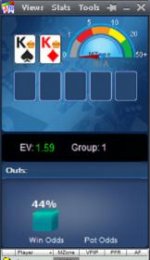
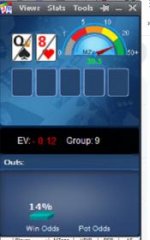
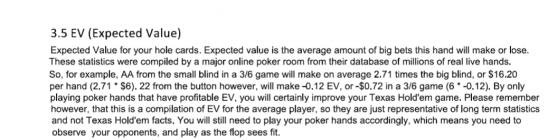


Hello again!
This is great! I was looking for a simple lesson to fully understand the ranges part and the thinking process! Well this seems like a simple introduction and I like it!
Thanks again for the knowledge! very excited to finish this book!
gl gl gl
This is great! I was looking for a simple lesson to fully understand the ranges part and the thinking process! Well this seems like a simple introduction and I like it!
Thanks again for the knowledge! very excited to finish this book!
gl gl gl


I love it,because the modern poker is about ranges,manny peaple tell you i put u is AA or KK,that is tottally wrong,other think manny peaple do is to judge a hand by his result, but you have to think in the long term iff my hand beat his rangue in a 60% is an easy call and forget wath was the result because u will be in that stop a lot off times and u will be winning a lot
belizebum said:Here are a couple of pictures of HUD and the program's explanation of EV.
View attachment 270052
View attachment 270053
View attachment 270054
Belize, this looks like a really cool program, but it's not a HUD in the way we're using that term in the book. We mean it to be a program that overlays stats on an online table during a session instead of an away-from-the-table study tool. Sorry we didn't clarify that well in our discussion!
FF2586 said:Hello again!
This is great! I was looking for a simple lesson to fully understand the ranges part and the thinking process! Well this seems like a simple introduction and I like it!
Thanks again for the knowledge! very excited to finish this book!
gl gl gl
Thanks FF, we really appreciate that!
Collin Moshman said:Belize, this looks like a really cool program, but it's not a HUD in the way we're using that term in the book. We mean it to be a program that overlays stats on an online table during a session instead of an away-from-the-table study tool. Sorry we didn't clarify that well in our discussion!
Thanks FF, we really appreciate that!
Oh it does that too, I was just showing the part where it shows the EV when playing.
I think this lesson is really valuable, and helps separate good players from bad players. I really need to start thinking more in ranges, because I can see the value that it has. Using ranges really makes your play more accurate I think, more based on fact than just playing your hand

Gravy_Police said:I’m enjoying this course so far. I put the villain on QQ+ so fairly tight but within the range of ranges ��
Thanks Collin and Katie for putting the course together and answering questions.
Peace
Stuart
+1 I am enjoying this course so far too. I was a bit shocked that by hand range was identical to Collin's though! (JJ+, AK) However, I also note that my answer was from the mindset of theory.
For instance, a friend of mine would play "Any Ace" in this spot (yeah, I know that is a bit too wide for theory but they have trouble folding any Ace they've admitted to me). So if I had live reads or information of my opponent then I would adjust the range accordingly. No information about them, I'd assign something like JJ+, AK range, but if I was playing my friend in this spot: then the range may include adding any Ace hands.
My question for Collin, or Katie (or anyone else informed) is: would adding any Ace to my friend's range be considered "non-congruent", or does "Any Ace" also "make sense" even if not optimal from a theory stand-point?
Phoenix Wright said:+1 I am enjoying this course so far too. I was a bit shocked that by hand range was identical to Collin's though! (JJ+, AK) However, I also note that my answer was from the mindset of theory.
For instance, a friend of mine would play "Any Ace" in this spot (yeah, I know that is a bit too wide for theory but they have trouble folding any Ace they've admitted to me). So if I had live reads or information of my opponent then I would adjust the range accordingly. No information about them, I'd assign something like JJ+, AK range, but if I was playing my friend in this spot: then the range may include adding any Ace hands.
My question for Collin, or Katie (or anyone else informed) is: would adding any Ace to my friend's range be considered "non-congruent", or does "Any Ace" also "make sense" even if not optimal from a theory stand-point?
I’d say you’re friend is playing an incongruent hand range. If you have information that an opponent is using an incongruent hand range then it makes sense to take that into consideration and put him on an incongruent range then play accordingly.