You are using an out of date browser. It may not display this or other websites correctly.
You should upgrade or use an alternative browser.
You should upgrade or use an alternative browser.


I’ve heard of this principle, but I don’t know anyone who could actually apply it. And it’s quite hard to imagine how it might work in the context of casino games. Do 20% of the slots generate 80% of the revenue?Ruslan L said:This principle is widely known. It states that approximately 80% of the outcome is attributable to 20% of the actions. Do you apply this principle in gambling, and if so, in which games specifically, and how has it affected your results?
It sounds good, but where would you get such statistics? Testing everything yourself is obviously far too expensive.





Ruslan L said:It states that approximately 80% of the outcome is attributable to 20% of the actions
Does that mean 20% of the players win 80% of the total winnings?
Ruslan L said:Do you apply this principle in gambling, and if so, in which games specifically, and how has it affected your results?
But honestly, I don't see how a player can apply that principal (Sorry). It seems to me that it's out of gamblers control.




Only vaguely aware of this principle but wouldn't surprise me if 20% of opponents in poker generate most of your winnings at a six handed table. Maybe learn to target the worst player more ruthlessly to maximise returns?



You can consider this principle in the context of the hands you play. I actually think that just 20% of hands generate 80% of our profit. At least, that’s how it looks in my game.nasty bent gorilla said:Only vaguely aware of this principle but wouldn't surprise me if 20% of opponents in poker generate most of your winnings at a six handed table. Maybe learn to target the worst player more ruthlessly to maximise returns?

80% of financial losses are caused by just 20% of systematic errors. If you can analyse your game and identify these errors, you can potentially prevent these losses.Ruslan L said:This principle is widely known. It states that approximately 80% of the outcome is attributable to 20% of the actions. Do you apply this principle in gambling, and if so, in which games specifically, and how has it affected your results?
It’s an option worth considering.





Pareto principle requires the analysis of data with natural tendencies to be able to determine the vital few & trivial many that will always happen. It does not apply to gambling. Gambling deals with random numbers & therefore does not sway to any natural tendency (unless there is a flaw or a cheat) that will always happen. 🙂

Gambling is a matter of chance – yes, that’s true. But things like bankroll management are certainly not a matter of chance. Players who know how to make money definitely need to stick to bankroll management, and I think this principle can certainly be applied in this field.YLAN said:Pareto principle requires the analysis of data with natural tendencies to be able to determine the vital few & trivial many that will always happen. It does not apply to gambling. Gambling deals with random numbers & therefore does not sway to any natural tendency (unless there is a flaw or a cheat) that will always happen. 🙂
How?R.Melnyk77 said:Players who know how to make money definitely need to stick to bankroll management, and I think this principle can certainly be applied in this field.
The application of pareto analysis resolves problems by correcting the vital few & repeats & repeats until the problem doesn't exist. If BR mgmt is already resolved by the pareto principle then BR mgmt problem would not exist. But it still exist because its causes & effect are not directly related.

I don’t know how this principle can be put into practice, but AI says there are several ways to apply it. I think it’s possible to apply this principle in some way if you set yourself that goal.YLAN said:How?
The application of pareto analysis resolves problems by correcting the vital few & repeats & repeats until the problem doesn't exist. If BR mgmt is already resolved by the pareto principle then BR mgmt problem would not exist. But it still exist because its causes & effect are not directly related.
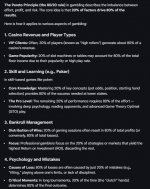


Thank you Lena M, this is very new and interesting to me.
The longer the tournament, I have noticed that I become tired and make mistakes. Which is very frustrating, cuz I am in top 3 in chips, and then as we are getting near the bubble, I lose concentration, make more mistakes and do not make it to the final table.
Is it a lack of discipline? I am not sure. But it happens often.
The longer the tournament, I have noticed that I become tired and make mistakes. Which is very frustrating, cuz I am in top 3 in chips, and then as we are getting near the bubble, I lose concentration, make more mistakes and do not make it to the final table.
Is it a lack of discipline? I am not sure. But it happens often.

No, I don’t know how to apply the Pareto principle. In any case, I doubt he was a better player than me. 🤣 As for my principles of playing at the casino, I trust my instincts. And in most cases, I make the right decisions (whether to keep playing or take a break). 💩


I think everything is relative. The 20/80 ratio can be found in many situations, in daily routines, gambling, or in business. But how to actually apply this principle in gambling, so that it gives us some positive result, I don't know for sure. And I think that the one who knows is unlikely to want to share this knowledge.
Honestly, I think that's actually the case. If we take all the players who are 100%, then I think that about 20% of the bottom will be the players who win 80% of the total profit.najisami said:Does that mean 20% of the players win 80% of the total winnings?
But honestly, I don't see how a player can apply that principal (Sorry). It seems to me that it's out of gamblers control.
And by the way, this makes sense. If you try to play only with strong cards, then in principle this will probably be somewhere around 20% of hands.MishkaZL said:You can consider this principle in the context of the hands you play. I actually think that just 20% of hands generate 80% of our profit. At least, that’s how it looks in my game.


I think the Pareto Principle applies very well to poker. A small number of skills tend to generate most of the results: bankroll management, table selection, emotional control, and solid preflop decisions.
Many players spend hours looking for advanced tricks while overlooking the fundamentals. In my experience, improving those core areas has always produced a much bigger impact than studying highly specific spots. The simple things done consistently are usually what move the needle the most.
Many players spend hours looking for advanced tricks while overlooking the fundamentals. In my experience, improving those core areas has always produced a much bigger impact than studying highly specific spots. The simple things done consistently are usually what move the needle the most.

What you call "a small amount of skill" in my opinion is the foundation of the game. In terms of poker, I think the Pareto principle is best reflected in the fact that 20% of the hands give us 80% of the results.bremp555 said:I think the Pareto Principle applies very well to poker. A small number of skills tend to generate most of the results: bankroll management, table selection, emotional control, and solid preflop decisions.
Many players spend hours looking for advanced tricks while overlooking the fundamentals. In my experience, improving those core areas has always produced a much bigger impact than studying highly specific spots. The simple things done consistently are usually what move the needle the most.



It is a very interesting principle, and it has some applications in casino, or a similar strategy, by selecting more carefully when are you really going to bet. You don't bet all the times you would bet, you bet fewer times, trying to reduse the loses,
Yes, this is an obvious and first example that can be given.infonazar said:What you call "a small amount of skill" in my opinion is the foundation of the game. In terms of poker, I think the Pareto principle is best reflected in the fact that 20% of the hands give us 80% of the results.

