Hi all!
I was looking forward to playing the Bronze Freebuy as an experienced MTT player, especially because freeroll fields tend to be very soft and players often call far too wide.
Very early in the tournament I picked up my first hand, AK and got involved in a hand that surprised me even by freeroll standards.
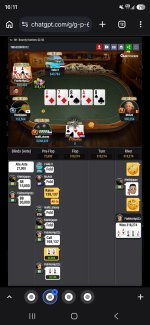
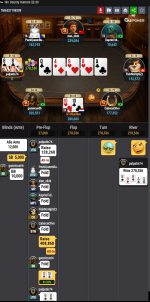
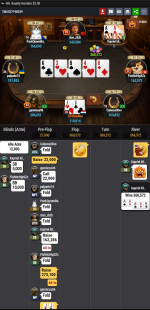
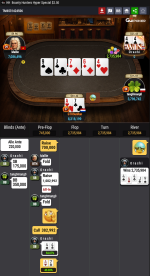
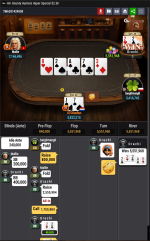
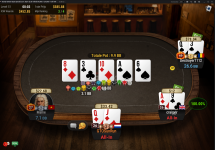
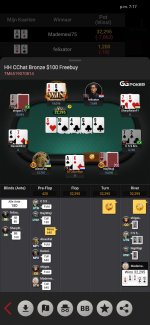
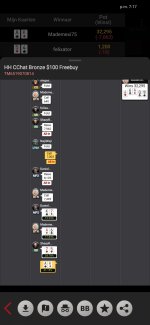
Hand history:
UTG+1 limps 1bb [Th X]
I am in LJ (LoJack) and isolate to 4bb [As Kd]
CO (Cutoff) calls 4bb [Ks 7d]
BTN (Button) calls 4bb [Ad 6c]
BB (Big Blind) shoves all-in for ~50bb [7h 5h]
LJ (me) calls ~50bb [As Kd]
CO then puts in ~55bb total [Ks 7d]
BTN calls ~51bb [Ad 6c]
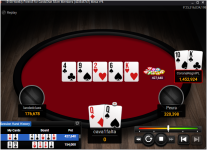
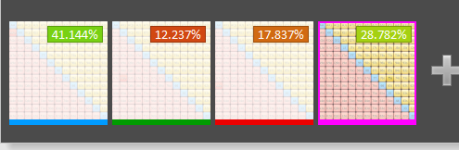
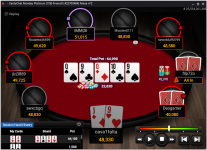
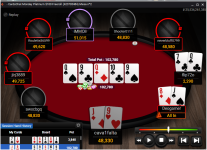
So we end up in a 4-way all-in while everyone still has a very playable stack, far above normal short-stack shove/fold territory.
I think this hand is a good example of why understanding ranges, domination and stack depth is so important.
My 4bb isolation raise over the UTG+1 limp should already represent a reasonably strong range. Because of that, the K7o flat from the CO is very loose. K7o suffers badly from domination and reverse implied odds: when it makes top pair, it can easily be against AK, KQ, KJ, etc.
The A6o flat from the BTN is also far too loose for similar reasons. A weak offsuit ace can easily make a dominated top pair against an isolation range.
Then the BB shoves around 50bb with 75s.
I think this is by far the biggest problem in the hand. 75s is a playable speculative hand in some situations, but turning it into a ~50bb squeeze shove against an isolation raise and two callers is extremely aggressive.
Interestingly, simply calling from the BB is much more defensible. After the limp, my 4bb raise and two callers, the BB only needs to add roughly another 3bb to enter a pot that will be around 17–18bb, depending on the exact ante structure.
That means the direct equity requirement is only around 17%, before considering postflop equity realization. With a connected suited hand like 75s, calling can therefore be reasonable.
But shoving ~50bb is a completely different decision.
The most important part then happens after the BB shove.
Once I call the ~50bb shove with AK, my range is obviously no longer the same wide isolation range I started with. My call should heavily concentrate toward strong hands.
This is where players need to understand that every new action changes the ranges involved.
K7o continuing for ~55bb after a 50bb shove AND my call is extremely difficult to justify. It is very often dominated and performs terribly against the ranges that should continue here.
A6o calling after the shove, my call, and the K7o continuation is even more problematic. By that point there are multiple players showing enormous strength, so A6o should expect to be dominated very frequently.
I am deliberately not looking at the final result of the hand when judging these decisions.
Results and variance do not determine whether a play was good or bad. What matters is whether the decision was profitable based on the information and ranges available at the moment the decision was made.
I am also not posting this to shame any of the players or complain about the result. I care much more about decision quality than whether I happened to win the hand.
I thought this was simply a useful example for newer players of how quickly ranges should narrow as more aggressive actions take place.
A hand can be playable before the action starts and become an easy fold after a raise, a shove and a call.
That is especially important when you still have 20bb, 30bb, 50bb+ stacks. Those stacks are highly playable. You do not need to take enormous marginal preflop gambles when you can preserve your stack and find much better opportunities through position, postflop play and exploitation of weaker opponents.
Curious to hear how others would analyse the different decisions in this hand.
I was looking forward to playing the Bronze Freebuy as an experienced MTT player, especially because freeroll fields tend to be very soft and players often call far too wide.
Very early in the tournament I picked up my first hand, AK and got involved in a hand that surprised me even by freeroll standards.
Hand history:
UTG+1 limps 1bb [Th X]
I am in LJ (LoJack) and isolate to 4bb [As Kd]
CO (Cutoff) calls 4bb [Ks 7d]
BTN (Button) calls 4bb [Ad 6c]
BB (Big Blind) shoves all-in for ~50bb [7h 5h]
LJ (me) calls ~50bb [As Kd]
CO then puts in ~55bb total [Ks 7d]
BTN calls ~51bb [Ad 6c]
So we end up in a 4-way all-in while everyone still has a very playable stack, far above normal short-stack shove/fold territory.
I think this hand is a good example of why understanding ranges, domination and stack depth is so important.
My 4bb isolation raise over the UTG+1 limp should already represent a reasonably strong range. Because of that, the K7o flat from the CO is very loose. K7o suffers badly from domination and reverse implied odds: when it makes top pair, it can easily be against AK, KQ, KJ, etc.
The A6o flat from the BTN is also far too loose for similar reasons. A weak offsuit ace can easily make a dominated top pair against an isolation range.
Then the BB shoves around 50bb with 75s.
I think this is by far the biggest problem in the hand. 75s is a playable speculative hand in some situations, but turning it into a ~50bb squeeze shove against an isolation raise and two callers is extremely aggressive.
Interestingly, simply calling from the BB is much more defensible. After the limp, my 4bb raise and two callers, the BB only needs to add roughly another 3bb to enter a pot that will be around 17–18bb, depending on the exact ante structure.
That means the direct equity requirement is only around 17%, before considering postflop equity realization. With a connected suited hand like 75s, calling can therefore be reasonable.
But shoving ~50bb is a completely different decision.
The most important part then happens after the BB shove.
Once I call the ~50bb shove with AK, my range is obviously no longer the same wide isolation range I started with. My call should heavily concentrate toward strong hands.
This is where players need to understand that every new action changes the ranges involved.
K7o continuing for ~55bb after a 50bb shove AND my call is extremely difficult to justify. It is very often dominated and performs terribly against the ranges that should continue here.
A6o calling after the shove, my call, and the K7o continuation is even more problematic. By that point there are multiple players showing enormous strength, so A6o should expect to be dominated very frequently.
I am deliberately not looking at the final result of the hand when judging these decisions.
Results and variance do not determine whether a play was good or bad. What matters is whether the decision was profitable based on the information and ranges available at the moment the decision was made.
I am also not posting this to shame any of the players or complain about the result. I care much more about decision quality than whether I happened to win the hand.
I thought this was simply a useful example for newer players of how quickly ranges should narrow as more aggressive actions take place.
A hand can be playable before the action starts and become an easy fold after a raise, a shove and a call.
That is especially important when you still have 20bb, 30bb, 50bb+ stacks. Those stacks are highly playable. You do not need to take enormous marginal preflop gambles when you can preserve your stack and find much better opportunities through position, postflop play and exploitation of weaker opponents.
Curious to hear how others would analyse the different decisions in this hand.
Attachments
Last edited: