Understanding gambling laws in the US can be tricky, as there is no federal minimum gambling age, and each state sets its own limit. Fortunately, our experts have in-depth knowledge of each state’s laws and are here to help you understand the legal status of online casinos, sweepstakes sites, tribal casinos, and more.

What is the Gambling Age in the US? Our Expert Guide for August 2026


State-by-State Guide to US Gambling Laws
The legal gambling age varies across states, and the gambling restrictions depend on the type of gambling you want to play, such as sweepstakes casinos or parimutuel gaming. Select your state below and find up-to-date information on the latest regulations and restrictions.
Select by State
Alabama
Alabama
Alabama is a strict anti-gambling state and only permits certain forms of gambling. The legalization of online casinos is extremely unlikely, as mobile gaming, sports betting, and lottery bills have failed in recent years.
Is Online Gambling Legal?
Status: Limited
Online gambling for real money is not available in Alabama. Some sweepstakes casinos are available, but many have left the state due to harsh regulations and cease-and-desist orders. There has never been a bill to legalize real-money online casinos, and sports betting bills consistently fail.
Are Land-Based Casinos Legal?
Status: Limited
Except for tribal gambling, brick-and-mortar casinos are not prevalent in Alabama. The Poarch Creek Indians operate three casinos. Attempts to pass broader gambling legislation have generally failed, and significant changes are unlikely in the near future.
Other types of gambling
Online Casinos
Sweepstakes Casinos
Tribal Casinos
Parimutuel Gaming
Prediction Markets
Daily Fantasy Sports
State Lottery
Legal Gambling Age by State
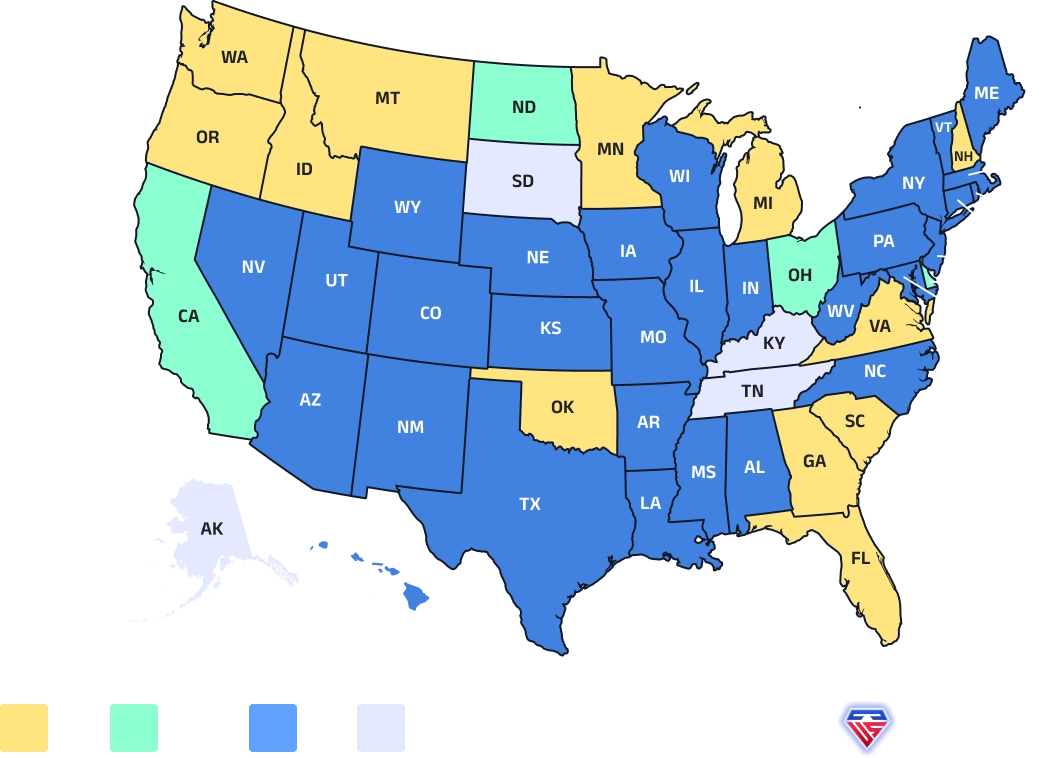
By now, you’ll know that the legal status of gambling differs greatly between states, and the same applies to legal gambling ages. The age limits can vary within each state depending on the casino or game you’re playing.
Check out our map below to see the legal gambling age in your state:
Which States Have Legal Gambling?
Even though many forms of gambling are legal under federal law, each state has different laws that relate to gambling. As a result, many states have decided against real-money online casinos, but land-based casinos, sweepstakes casinos, and prediction markets are prevalent.
States with parimutuel gaming
44
Why Aren’t Online Casinos More Widely Available?
Online casinos were illegal across the country until 2012, when Delaware became the first state to legalize internet gambling. Considering that this is still relatively recent, it’s no surprise that only six other states have followed suit.
Many states remain strict towards gambling due to social and religious views. Even in some states where lawmakers have more favorable views, such as New Hampshire, residents often remain opposed.
It’s also argued that regulating online casinos would be too difficult. Land-based casinos are arguably easier to manage and restrict illegal activity.
Our Experts' Guide on Legal Online Gambling
Currently, seven states offer real-money online casinos, with Maine soon to join. States such as Michigan, New Jersey, and Pennsylvania have demonstrated the positives that could catch the eye of more restrictive states.
For example, in New Jersey, online casinos are the most successful gambling market in the state. In 2025, New Jersey’s online gambling revenue increased 22%, reaching almost $3 billion. In Pennsylvania, iGaming revenue was $3.5 billion.
While real-money casinos are the best option for gaming online, they’re not the only option for players across the US.

Sweepstakes Casinos
In recent years, sweepstakes and social casinos have provided a legal alternative to online casinos, allowing you to play casino games in states where real-money gambling isn’t permitted.
Sweepstakes casinos use a no-purchase-necessary model with virtual currencies: Gold Coins (GC) and Sweeps Coins (SC). This means they can offer slots, table games, live dealer titles, and more in many states.
However, it’s important to note that many states, such as California and Nevada, have recently banned sweepstakes casinos. Check out the above guide to find out the latest legal updates on sweepstakes casinos in your state.

Prediction Markets
Prediction markets have gained incredible traction in the US over recent years. You can trade on the outcome of real-world events instead of placing a fixed-odds bet. Essentially, you’re purchasing contracts on outcomes that you predict may (or may not!) happen.
Most markets offer a “Yes” or “No” option. For example, you can predict the nominees for the next presidential election or the winner of the Super Bowl.
While only one state (Minnesota) has specifically outlawed prediction markets, some states have issued warnings and are revoking licenses from sites.

Parimutuel Betting
Casino-style sites using a parimutuel gaming model have also emerged recently. They are unique Reveal Gaming platforms that combine casino-style gameplay with real horse-racing results.
You can play traditional casino games, such as slots, video poker, jackpots, and Plinko. The key difference between these platforms and standard casinos is that the results are tied to real horse races rather than to random number generator (RNG) games.
While not available in most states, parimutuel gaming sites like Horseplay are legally regulated and offered in 18 states.

Jordan Marley
Sweepstakes Casino Expert

31 reviews written for Casino.us
My favorite sweepstakes casino is Stake.us, which offers huge bonuses for new players. Use our exclusive bonus code CUS to pick up 560,000 Gold Coins and $56 Stake Cash!
Federal Gambling Laws – A Brief History
In addition to state laws, the US is also subject to federal laws. These apply to the entire United States, although some state laws conflict with their federal counterparts.
1
1961 - Interstate Wire Act
This law prohibits certain types of betting businesses in the USA. The text itself refers to “bets or wagers on any sporting event or contest”, which is vague wording that was difficult to clarify.
2
1970 - Illegal Gambling Business Act
The main targets of this act were large gambling operations. The government believed, accurately in some cases, that such operations were connected to and/or financing organized crime.
3
1992 – Professional and Amateur Sports Protection Act (PASPA)
This act prohibited sports gambling under state law, but it has since been overturned.
4
2006 - Unlawful Internet Gambling Enforcement Act (UIGEA)
This act prohibits gambling businesses from “knowingly accepting payments in connection with the participation of another person in a bet or wager that involves the use of the Internet.”
5
2018 – PASPA overturned
The U.S. Supreme Court ruled that PASPA was unconstitutional. This landmark decision struck down the federal ban on sports betting.
Can I Be Taxed on My Gambling Winnings?
Gambling wins are fully taxable and must be reported as income on your federal tax return. If you’re serious about gambling, we advise discussing taxation on gambling activity with an accountant or tax expert with relevant experience in your state.
Gambling income includes winnings from online casinos, sweepstakes casinos, lotteries, raffles, sports betting, and horse races.
Are There Federal Taxes on My Winnings?
Most gambling wins are subject to federal taxation, usually at a flat rate of 24%. If you win $600+ at an online casino, $1,200+ on slot machines or bingo games, $1,500+ on keno, or $5,000+ on wagering pools or lotteries, you will be taxed.
What About State Taxes?
As well as at the federal income tax level, you may also need to pay state income tax on gambling winnings. Each state sets its own tax level.
The only states that don’t require residents to pay state income tax are as follows:
- Alaska*
- California
- Florida*
- Hawaii
- Nevada*
- New Hampshire*
- South Dakota*
- Tennessee*
- Texas*
- Utah
- Washington*
- Wyoming*
*States marked with an asterisk either don’t have any state income tax or don’t tax earned wages, so gambling is only exempt because it falls under that heading.
Responsible Gambling: Stay in Control
While gambling laws may be confusing, it’s always important to remain in control of your gambling. It’s possible to enjoy online casinos and protect your bankroll at the same time. If you’re concerned about gambling habits, find some responsible gambling organizations you can reach out to here:

National Council on Problem Gambling
The National Council on Problem Gambling is an advocate for those impacted by problem gambling. They provide support, education, and 24/7 helpline services for all US residents.
Phone: 1-800-MY-RESET

Gamblers Anonymous
Gamblers Anonymous offers a recovery program for those struggling with compulsive gambling. The support groups involve peer-led meetings, and everyone remains anonymous. Meetings are held in all 50 states, both in-person and virtually.
Phone: 909-931-9056