

How Mad is March Madness?
Shocks and underdog stories are common theme in sport; but is March Madness truly the maddest?
It’s almost time for the craziest tournament in sports; as 68 teams go to battle over an exhilarating 24 days.
It’s a competition that truly provides an underdog story almost every year; who can forget minnows Farleigh Dickinson beating no.1 ranked Purdue in 2023? Or Virginia’s shock defeat to UMBC 5 years earlier?
A huge year of sport continues; we’ve already seen the Super Bowl, and the World Cup is hosted on this very soil in June 2026.
Utilizing data between 2015-2025, we analyzed every result from men’s March Madness, NFL play-offs, NBA play-offs, the MLB World Series and the last four Soccer World Cups to find out which competition is really the craziest.
Key findings:
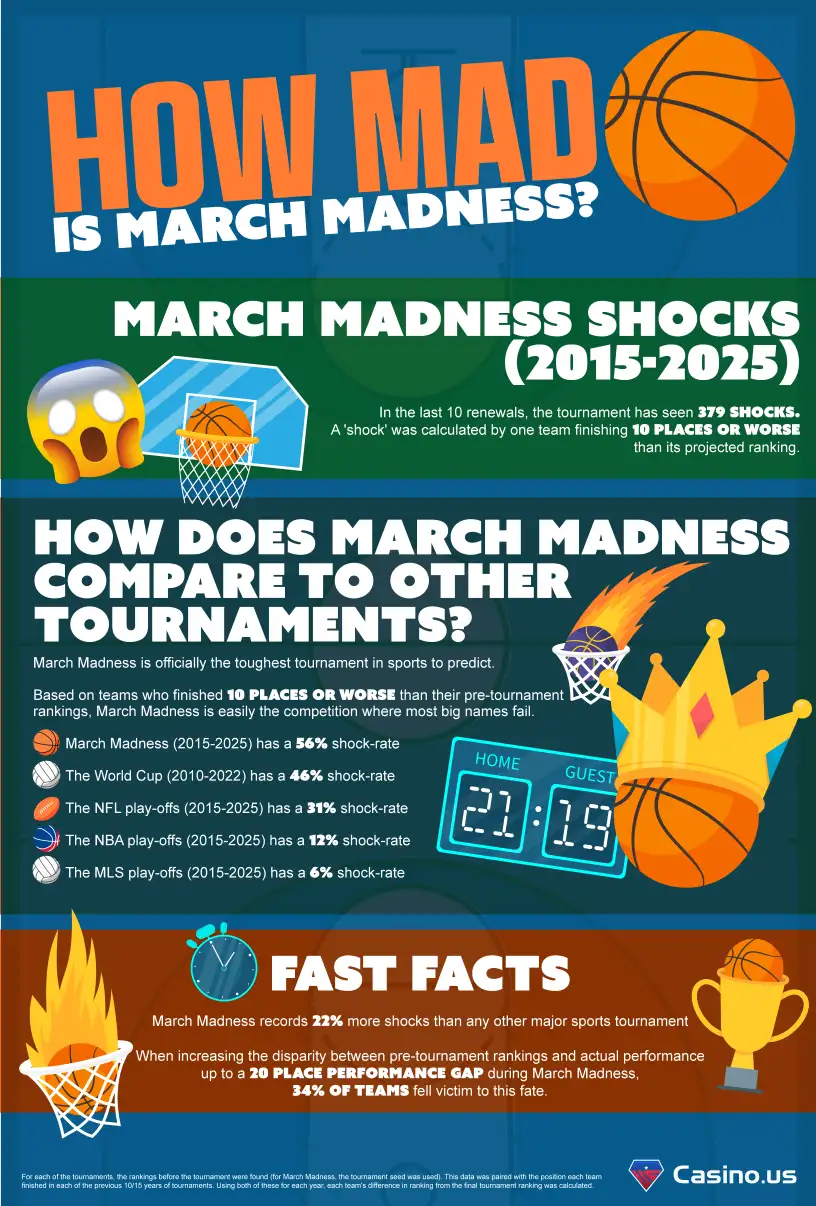
- March Madness records 22% more shocks than any other major tournament
- Based on pre-tournament rankings, 56% of teams exit the competition at 10 or more positions lower than expected
- The World Cup is the second most unpredictable tournament, with 46% of teams flopping by at least 10 places below their pre-tournament ranking
- Despite being favored most years, Arizona Wildcats are regular disappointments (finishing on average 22 positions behind their pre-tournament ranking over the last decade)
- The top ‘bracket-busters’ on average are Michigan Wolverines, UCLA Bruins and Gonzaga Bulldogs. All three, on average, regularly beat their pre-tournament ranking expectations.
Why March Madness is so unpredictable
Compared with other global sporting tournaments, the numbers show that March Madness is uniquely chaotic.
When we analysed the last decade of major competitions, teams in the NCAA tournament finished an average of 16 places away from their expected ranking, based on their pre-tournament seed.
That’s significantly higher than the 13-place swing seen in the FIFA World Cup, and dramatically higher than major American leagues like the NBA playoffs and MLB playoffs (both 4 places lower than expected on average).
The difference comes down to format. The World Cup gives elite teams multiple group-stage matches to recover from mistakes, while professional playoffs use best-of-series formats. March Madness offers neither luxury; a single of underperformance often results in elimination.
Does March Madness produce the most surprises?
The data suggests so, and by a wide margin. Across the tournaments analyzed, we defined a “major shock” as a team finishing 10 or more places away from its expected ranking. By that measure, March Madness produced 379 major shocks in the dataset between 2015-2025.
That’s not just more than any other competition, it’s more than the NBA playoffs, NFL playoffs, MLB playoffs and World Cup combined, which together produced 135 shocks over the same timeframe.
March Madness alone accounted for around 74% of all major ranking shocks in the dataset.
The reason is partly mathematical. With 68 teams competing in a straight knockout bracket, the tournament creates far more opportunities for unexpected results.
Lower-seeded teams only need to win a few games to massively exceed expectations, while favorites risk a dramatic drop in expected overall competition performance with an early defeat.
Is your bracket doomed before March Madness even begins?
Every March, millions of fans attempt the impossible; predicting a perfect NCAA tournament bracket.
According to the NCAA, nobody has ever recorded a perfect bracket; the best effort being 49 games correctly predicted in a row.
In the dataset, 56% of teams finished at least 10 places away from their expected ranking.
Even more striking, 34% of teams finished 20 or more places away from their projected position. That means roughly one in three teams ends up wildly outperforming or underperforming its seed.
For comparison, the NBA and MLB playoffs recorded 0 outcomes with a 20-place ranking swing over the same period.
Let the madness begin.
Methodology
For each of the tournaments, the rankings before the tournament were found (for March Madness, the tournament seed was used).
This data was paired with the position each team finished in each of the previous 10/15 years of tournaments. Using both for each year, each team's difference in ranking from the final tournament ranking was calculated.
To find SRS (Simple Rating System) rankings, the SRS number for each team in the league for each season was used to rank the teams for each year. The teams were then ranked by their final position in the playoffs, and this was used to calculate the difference in ranking.
For teams that have changed names, the most up to date name was used.
For the World Cup (2010-2022), the pre-tournament rank was taken from the FIFA World rankings, from the most recent update prior to the start of the tournament each year. For each team, the final position in the tournament was recorded, and the difference between the pre-tournament ranking and the final ranking was calculated.
Fair use
You are welcome to use this content and graphic as part of your coverage. Please credit and link this page if doing so, to provide credit to the researchers and authors.